
Note: This article is written from a synthesis of current U.S. labor-market, inflation, Federal Reserve, and economic research sources. It does not include source links, so it is ready for web publishing.
Introduction: Why Wages and Inflation Always Seem to Argue at the Dinner Table
Wages and inflation have one of the most important relationships in the economy. They are not exactly enemies, not exactly friends, and definitely not the kind of couple you would invite to a peaceful dinner party. When wages rise, workers can afford more. When inflation rises, the same paycheck buys less. When both rise at the same time, households, businesses, and policymakers start squinting at spreadsheets like they are trying to decode ancient treasure maps.
The relationship between wages and inflation matters because it affects nearly every financial decision people make: buying groceries, asking for a raise, hiring employees, setting prices, saving for retirement, or deciding whether that “small” coffee purchase is now a luxury item with foam. In simple terms, wages represent what workers earn, while inflation measures how quickly prices increase across the economy. The big question is whether paychecks are growing fast enough to keep up with the cost of living.
In the United States, this topic became especially important after the pandemic-era inflation surge. Prices rose quickly, wages followed unevenly, and many households felt squeezed even when their nominal pay increased. That is the tricky part: a raise may look good on paper, but if rent, food, insurance, gas, and childcare rise faster, that raise can feel like a trophy made of cardboard.
This article explains how wages and inflation interact, why economists worry about wage-price spirals, how real wages reveal the truth behind pay growth, and what this relationship means for workers, employers, and the broader economy.
What Are Wages?
Wages are the payments workers receive for their labor. They can appear as hourly pay, salaries, commissions, bonuses, tips, or other forms of compensation. In economic discussions, wages are often measured through average hourly earnings, median wages, employment cost indexes, or wage trackers that follow how pay changes over time.
Nominal Wages vs. Real Wages
To understand the relationship between wages and inflation, it is essential to separate nominal wages from real wages.
Nominal wages are the actual dollar amount workers receive. If someone earns $25 per hour this year and earned $24 per hour last year, their nominal wage increased.
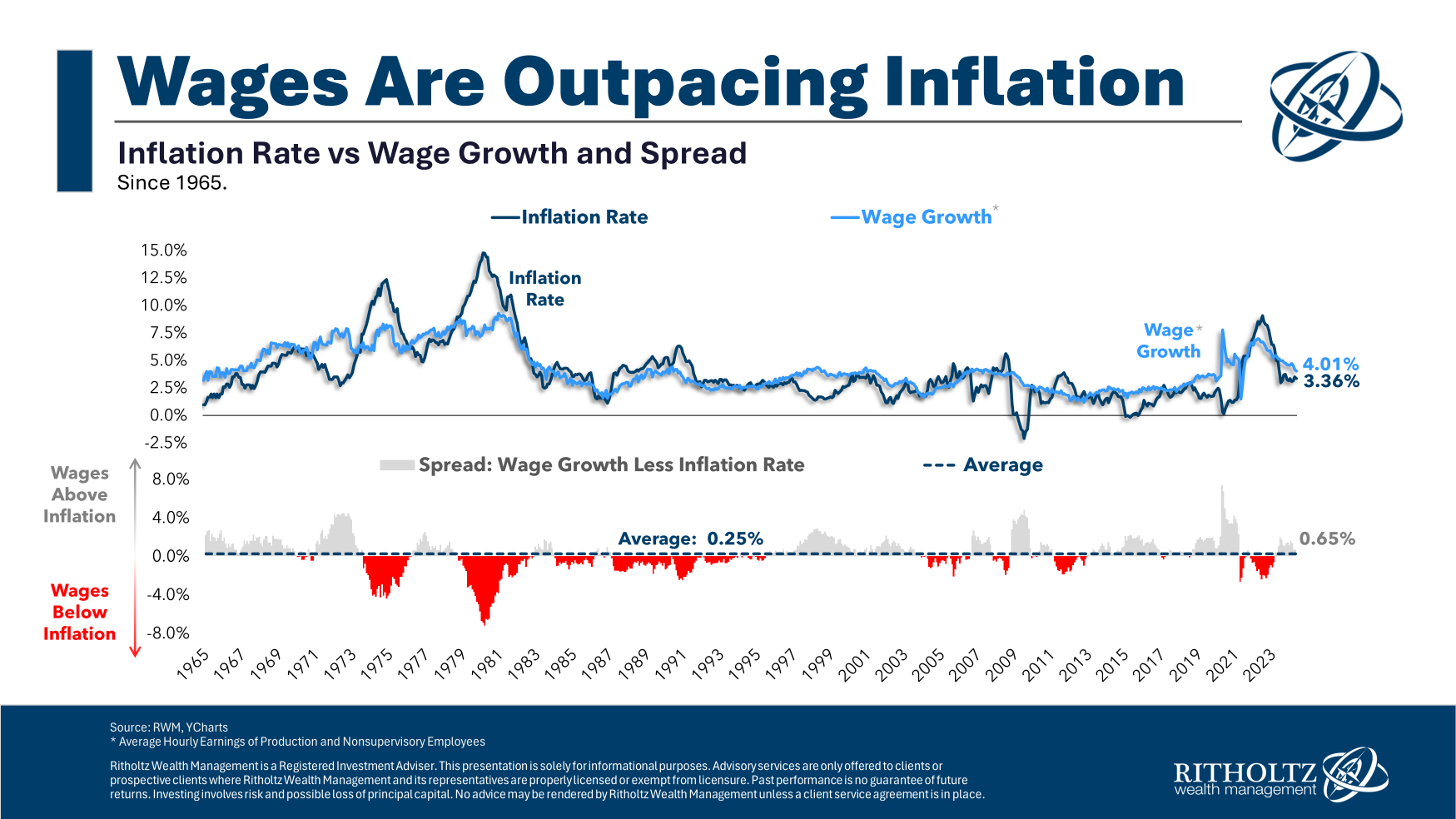
Real wages adjust wages for inflation. They show how much purchasing power a worker actually has. If wages rise by 4% but inflation rises by 5%, real wages fall because prices are growing faster than pay. In that situation, the worker technically earns more dollars but can buy less stuff. It is the economic version of running on a treadmill while someone slowly turns up the speed.
Real wages are often the better measure of living standards because people do not pay bills with percentage increases; they pay with purchasing power.
What Is Inflation?
Inflation is the rate at which the general level of prices rises over time. When inflation increases, money loses purchasing power. A dollar still looks like a dollar, but it becomes less muscular at the checkout counter.
In the United States, inflation is commonly measured by indexes such as the Consumer Price Index, or CPI, and the Personal Consumption Expenditures Price Index, or PCE. CPI tracks price changes for a basket of goods and services commonly purchased by households, including food, housing, transportation, medical care, and energy. The Federal Reserve tends to focus heavily on PCE inflation when setting monetary policy.
Inflation can come from several sources. Demand-pull inflation happens when consumers and businesses spend more than the economy can comfortably supply. Cost-push inflation occurs when production costs rise, such as higher oil prices, supply-chain disruptions, or increased input costs. Built-in inflation happens when people expect prices to rise and adjust wages, contracts, and pricing decisions accordingly.
How Wages and Inflation Are Connected
The connection between wages and inflation works in both directions. Inflation can push workers to demand higher pay, and higher wages can push businesses to raise prices. However, the relationship is not automatic, simple, or identical across all industries.
Inflation Can Reduce Purchasing Power
When inflation rises faster than wages, workers lose purchasing power. A household may receive a raise but still struggle because essentials become more expensive. This is why many people can feel poorer even during periods of low unemployment or steady wage growth.
For example, imagine a worker earns $50,000 per year and receives a 3% raise, bringing annual pay to $51,500. That sounds nice. But if inflation rises 5%, the cost of living increases faster than income. The worker has more dollars but less real buying power. The paycheck got bigger, but the grocery cart got sneakier.
Wage Growth Can Support Consumer Spending
When wages rise faster than inflation, workers gain purchasing power. This can strengthen consumer spending, which is a major driver of the U.S. economy. Higher wages may allow families to eat out more, upgrade appliances, travel, save, invest, or finally replace that couch that has been “temporarily” sagging since 2016.
Healthy wage growth is not bad for the economy. In fact, rising real wages are often a sign that workers are sharing in economic growth. The challenge is making sure wage growth is supported by productivity gains, strong business investment, and stable inflation expectations.
Labor Costs Can Influence Business Prices
For many businesses, labor is one of the largest costs. When wages rise, employers may respond in several ways. They might accept lower profit margins, improve productivity, raise prices, reduce hiring, automate tasks, or adjust benefits and hours.
If businesses broadly raise prices to cover higher wage costs, wage growth can contribute to inflation. However, this depends on the industry. A restaurant with thin margins may pass wage increases to customers more quickly than a software company with high profit margins and scalable products.
The Wage-Price Spiral: Real Risk or Economic Ghost Story?
A wage-price spiral occurs when rising prices lead workers to demand higher wages, and rising wages lead businesses to raise prices again. This cycle can repeat, making inflation harder to control.
The wage-price spiral is one of the most famous concerns in inflation economics. It sounds dramatic because it is dramatic. Economists say “wage-price spiral,” but regular people might call it “everything gets more expensive and nobody is having a good time.”
How a Wage-Price Spiral Works
A basic wage-price spiral can unfold like this:
- Prices rise across the economy.
- Workers demand higher pay to keep up with living costs.
- Businesses raise wages to attract and retain workers.
- Businesses increase prices to cover higher labor costs.
- Consumers face higher prices again.
- Workers demand another round of wage increases.
This process can become dangerous when inflation expectations become unanchored. In other words, if workers and businesses believe inflation will remain high, they may behave in ways that make high inflation more likely. Workers ask for larger raises. Businesses preemptively raise prices. Contracts include larger cost-of-living adjustments. The expectation becomes part of the reality.
Why Wage-Price Spirals Are Not Inevitable
Despite the scary name, wage-price spirals do not happen every time wages rise. Wage growth can exceed inflation for a period without creating runaway inflation, especially when workers are recovering lost purchasing power after a period of high prices.
Several factors can limit wage-price spirals. Productivity growth allows businesses to pay workers more without raising prices as much. Competition can prevent firms from passing all costs to customers. Profit margins can absorb some wage increases. Workers may also have limited bargaining power, especially in industries where job switching is difficult.
In recent U.S. economic debates, many economists have argued that post-pandemic inflation was driven heavily by supply disruptions, energy prices, housing costs, strong demand, and global shocksnot simply wages. Wage growth mattered, but it was only one ingredient in the inflation stew. And like actual stew, blaming only the carrots would be unfair.
Why Real Wages Matter More Than Headline Raises
One of the most useful ways to analyze wages and inflation is to look at real wages. Real wages tell us whether workers are getting ahead, falling behind, or standing still while pretending not to panic.
For example, if average hourly earnings rise 3.5% over a year while consumer prices rise 3.3%, real wages rise slightly. That means workers gain a little purchasing power. If wages rise 3.5% while inflation rises 6%, workers lose ground. This is why the gap between wage growth and inflation is so important.
The Household View
From a household perspective, inflation is personal. Economists measure broad price indexes, but families experience inflation through the specific things they buy. A household with high rent, long commutes, or major medical expenses may feel inflation more sharply than the national average suggests.
This is why some workers feel frustrated even when official data show improving real wages. If the prices rising fastest are the prices that dominate a family’s budget, the improvement may not feel real. Averages are useful, but nobody feeds their children with an average.
The Employer View
Employers also experience wage inflation differently. A business in a tight labor market may need to raise pay quickly to retain employees. A company facing weak demand may struggle to raise wages without cutting elsewhere. Small businesses may have less flexibility than large corporations because they often have smaller cash reserves and less pricing power.
For employers, the wage-inflation relationship becomes a balancing act. Pay too little, and good workers leave. Pay too much without productivity gains, and costs rise. Raise prices too aggressively, and customers leave. Running a business during inflation can feel like juggling plates while the floor is moving.
Productivity: The Missing Piece in the Wage and Inflation Puzzle
Productivity measures how much output workers produce per hour. It is one of the most important factors in determining whether wages can rise without fueling inflation.
When productivity improves, businesses can afford higher wages because each worker produces more value. For example, if a factory invests in better equipment or a software company improves its tools, employees may produce more in the same amount of time. Higher output can support higher pay without requiring large price increases.
This is why long-term wage growth depends heavily on productivity growth. If wages rise because workers are producing more, the economy can enjoy stronger incomes with less inflation pressure. If wages rise much faster than productivity for a long period, businesses may face stronger pressure to raise prices.
Technology and Productivity
Technology can improve productivity, but the effects are not always immediate. Artificial intelligence, automation, better logistics, and improved software may eventually help companies produce more efficiently. However, businesses need time to adopt new tools, train workers, reorganize operations, and figure out which shiny new technology is actually useful and which one is just a very expensive screensaver.
If productivity grows strongly, wages and living standards can improve. If productivity disappoints, wage increases may be harder to sustain without inflationary pressure.
How the Federal Reserve Looks at Wages and Inflation
The Federal Reserve pays close attention to wages, inflation, employment, and inflation expectations. Its job is not to prevent workers from getting raises. Its broader goal is to promote maximum employment and stable prices.
When inflation is high, the Fed may raise interest rates or keep rates restrictive to slow demand. Higher rates can make borrowing more expensive, which may cool spending, investment, hiring, and price growth. However, rate hikes can also weaken the labor market if they slow the economy too much.
This creates a difficult trade-off. If the Fed acts too softly, inflation may remain high and erode purchasing power. If it acts too aggressively, unemployment may rise and wage growth may slow. Monetary policy is basically a thermostat for the economy, except the room is huge, the windows are open, and half the guests keep changing the temperature.
Why the Fed Watches Wage Growth
The Fed watches wage growth because persistent, unusually rapid wage increases can signal labor-market tightness and possible inflation pressure. But wage growth alone does not determine inflation. The Fed also looks at productivity, profit margins, consumer demand, supply conditions, commodity prices, housing costs, and expectations.
In a healthy economy, wages can rise steadily while inflation remains moderate. The key is whether wage growth is consistent with productivity and the Fed’s long-run inflation goals.
Do Higher Wages Cause Inflation?
The honest answer is: sometimes, partly, and not by themselves. Higher wages can contribute to inflation if they significantly raise business costs and those costs are passed on to consumers. But wages are only one part of the inflation story.
Inflation can rise because of supply shortages, energy shocks, tariffs, strong consumer demand, housing constraints, transportation bottlenecks, or corporate pricing decisions. During the post-pandemic period, several of these forces operated at once. Wages rose, but so did shipping costs, energy prices, housing costs, and demand for goods and services.
Blaming inflation entirely on wages is too simple. It also risks treating workers’ paychecks as the villain when many workers are simply trying to maintain their standard of living. At the same time, pretending wages have no connection to inflation is also too simple. Labor costs matter, especially in service industries where human work is the product.
Do Higher Prices Cause Higher Wages?
Yes, inflation often leads workers to seek higher wages. When employees see rent, groceries, insurance, and transportation costs rise, they naturally want pay that keeps up. This can happen through individual raises, job switching, union negotiations, minimum wage adjustments, or cost-of-living increases.
However, wages do not always adjust quickly. Many workers receive raises only once a year. Others have limited bargaining power. Some employers resist wage increases because they worry about costs. As a result, inflation can hit households quickly while wage adjustments arrive slowly. Prices take the elevator; wages often take the stairs.
Why Job Switching Often Matters
Workers who switch jobs often see faster wage growth than workers who stay in the same job. This is especially true in tight labor markets, when employers compete for talent. During periods of high inflation, job switching can become a way for workers to recover lost purchasing power.
However, job switching is not equally available to everyone. Workers with specialized skills, strong networks, or high-demand occupations may have more bargaining power. Workers with caregiving responsibilities, transportation limits, immigration concerns, health challenges, or fewer local job options may have less flexibility.
This means wage inflation is not evenly distributed. Some workers gain strong raises, while others fall behind. The relationship between wages and inflation is not just macroeconomic; it is also deeply personal and unequal.
Industry Differences: Not All Wages Move the Same Way
Different industries experience wage and inflation pressures differently. In leisure, hospitality, retail, health care, construction, logistics, and manufacturing, labor-market conditions can vary widely.
Service Industries
Service industries often rely heavily on labor. Restaurants, hotels, childcare centers, home health agencies, and personal services may feel wage increases quickly. If wages rise, these businesses may need to increase prices unless productivity improves or margins absorb the costs.
Goods-Producing Industries
Manufacturing and construction may be more affected by materials, energy, transportation, and financing costs. Wages still matter, but inflation may also come from steel, lumber, fuel, machinery, or supply-chain delays.
High-Skill Industries
In technology, finance, engineering, and professional services, wages can be high, but firms may have greater ability to scale output. Labor costs matter, yet pricing power, productivity, and profit margins may soften the inflationary effect.
Minimum Wage, Inflation, and Living Costs
Minimum wage policy is often part of the wages and inflation debate. Supporters of higher minimum wages argue that low-paid workers need better incomes to afford basic necessities. Critics worry that higher labor costs may raise prices or reduce hiring.
Research generally suggests that moderate minimum wage increases can raise earnings for low-wage workers with limited price effects, though outcomes vary by location, industry, and economic conditions. A minimum wage increase in a high-cost city may have different effects than the same increase in a rural area with lower living costs.
The key issue is balance. If wages at the bottom do not rise, workers may struggle to afford essentials. If wage mandates rise too quickly for some businesses, employers may adjust through prices, hours, staffing, or automation.
Inflation Expectations: The Psychology Behind the Numbers
Inflation is not only about current prices. It is also about what people expect prices to do next. If workers expect inflation to remain high, they may ask for larger raises. If businesses expect higher costs, they may raise prices sooner. If consumers expect prices to rise, they may buy earlier, which can increase demand.
This is why central banks care so much about inflation expectations. Stable expectations help prevent temporary price shocks from becoming permanent inflation. When expectations remain anchored, people trust that inflation will eventually return to a normal range. When expectations drift upward, the economy becomes harder to manage.
In plain English, expectations are the economy’s group chat. If everyone starts texting “prices are going up forever,” behavior can change fast.
What the Wage-Inflation Relationship Means for Workers
For workers, the most important question is whether income is keeping up with living costs. A raise is helpful only if it improves real purchasing power. Workers should pay attention not only to salary but also to benefits, commuting costs, health insurance, retirement contributions, schedule flexibility, and career growth.
During inflationary periods, workers may protect themselves by improving skills, comparing market pay, negotiating raises, reducing high-interest debt, and building emergency savings when possible. Not everyone has equal room to maneuver, but understanding inflation-adjusted wages can help people make better decisions.
What the Wage-Inflation Relationship Means for Employers
For employers, inflation creates pressure from both sides. Workers want higher pay because living costs are rising, while customers may resist higher prices. Businesses that handle this well often focus on productivity, retention, smarter scheduling, better technology, and transparent compensation strategies.
Raising wages can be expensive, but replacing workers is also expensive. Turnover costs include recruiting, training, lost productivity, lower morale, and customer service problems. Sometimes paying people fairly is not only ethical; it is cheaper than running a revolving door with a payroll system attached.
What the Wage-Inflation Relationship Means for the Economy
At the national level, the ideal outcome is steady wage growth, low unemployment, productivity gains, and moderate inflation. In that scenario, workers earn more, businesses grow, and prices remain predictable.
Problems arise when inflation persistently outpaces wages or when wage growth becomes disconnected from productivity. If inflation beats wages, living standards decline. If wage growth fuels persistent price increases, inflation may become harder to control. The goal is not to suppress wages; the goal is to create conditions where wages can rise sustainably.
Practical Examples of Wages and Inflation
Example 1: The Raise That Wasn’t Really a Raise
Maria earns $60,000 and receives a 4% raise. Her new salary is $62,400. But if inflation is 5%, her real purchasing power falls. She earns $2,400 more in nominal terms, but her cost of living rises faster. Maria may feel confused because she received good news from her employer and bad news from her grocery receipt.
Example 2: The Business Facing Higher Payroll Costs
A neighborhood restaurant raises wages to keep cooks and servers from leaving. Payroll costs increase. The owner responds by raising menu prices slightly, simplifying the menu, improving scheduling, and reducing food waste. In this case, wage growth affects prices, but productivity improvements and operational changes reduce the impact.
Example 3: Productivity Makes Higher Wages Easier
A logistics company invests in better routing software. Drivers complete more deliveries with less wasted time. The company raises wages to retain employees but does not need to raise prices as much because productivity improved. This is the sweet spot: better pay supported by better output.
Common Myths About Wages and Inflation
Myth 1: All Wage Increases Cause Inflation
Not true. Wage increases supported by productivity growth, lower turnover, or reduced profit margins may have limited inflation effects. The context matters.
Myth 2: Inflation Helps Workers Because Wages Rise
Not always. Wages often lag behind prices. Inflation can hurt workers badly if pay does not keep up.
Myth 3: Businesses Always Raise Prices Only Because Wages Rise
Also false. Prices can rise because of energy costs, rent, supply shortages, financing costs, taxes, tariffs, demand surges, or strategic pricing decisions.
Myth 4: Real Wages Are Too Abstract to Matter
Real wages are extremely practical. They answer the question people actually care about: “Can I afford more, less, or about the same as before?”
Experience-Based Insights: What the Wage-Inflation Relationship Feels Like in Real Life
The relationship between wages and inflation becomes much clearer when viewed through everyday experience. Imagine an employee who receives a raise after a strong performance review. At first, the raise feels like progress. There is relief, pride, and maybe even a small celebration involving takeout that costs more than expected. But a few months later, rent renews at a higher rate, grocery totals keep climbing, insurance premiums increase, and the raise starts to feel thinner. The worker is not imagining things. That is the difference between nominal wage growth and real wage growth showing up in daily life.
Many households experience inflation not as one giant number, but as a series of small annoyances that pile up. A carton of eggs costs more. A utility bill jumps. A car repair becomes painful. A family vacation gets postponed because airfare and hotel prices are suddenly acting like they have celebrity agents. Even when wages rise, people may still feel financially behind because inflation touches the necessities first. Food, housing, fuel, and healthcare are not optional expenses. Nobody says, “I’ll skip shelter this month and circle back later.”
Workers often respond by becoming more strategic. Some compare salaries online, ask colleagues about industry pay ranges, or look for new jobs. Others request cost-of-living raises or negotiate remote work to reduce commuting expenses. In many cases, people discover that the fastest way to beat inflation is not waiting patiently for a standard annual raise, but improving bargaining power. That may mean learning new skills, switching employers, joining a higher-paying industry, or taking on certifications that make their labor more valuable.
Employers feel the pressure too. A small business owner may want to raise wages but worry about whether customers will accept higher prices. They may test price increases carefully, improve efficiency, reduce waste, or offer non-wage benefits such as flexible schedules. In tight labor markets, employers learn that underpaying workers can be more expensive than raising wages because turnover damages service quality and forces constant retraining. A stable, experienced team can be a productivity advantage.
From a consumer perspective, inflation can also change behavior. People become more price-sensitive. They trade down to cheaper brands, delay big purchases, cook more at home, cancel subscriptions, or drive less. These choices can eventually cool demand, which may reduce inflation pressure. But they also show how inflation affects quality of life. The wage-inflation relationship is not just a chart in an economics report. It is the reason someone chooses between saving money and replacing worn-out shoes.
One of the most important lessons from recent years is that people care about levels, not just growth rates. Even if inflation slows, prices may remain much higher than they were before. A slower increase is better than a faster increase, but it does not automatically make life feel affordable again. Workers may continue demanding higher wages because they are trying to catch up to the new price level, not just respond to this month’s inflation rate.
The best real-world outcome is not low wages and low inflation. It is rising real wages with stable prices. That means workers earn more after adjusting for inflation, businesses improve productivity, and households can plan without feeling ambushed by every receipt. In practical terms, wages and inflation should be watched together. Looking at only wages can make the economy seem stronger than it feels. Looking at only inflation can ignore income gains. The full picture comes from comparing bothand asking whether ordinary people are actually getting ahead.
Conclusion: Wages and Inflation Are a Balancing Act
The relationship between wages and inflation is one of the central forces shaping household finances, business decisions, and economic policy. Wages determine how much people earn, while inflation determines how much those earnings can buy. When wages rise faster than inflation, workers gain purchasing power. When inflation rises faster than wages, households lose ground even if paychecks look larger.
Higher wages do not automatically cause inflation, and inflation does not automatically produce fair wage growth. The connection depends on productivity, labor-market strength, business pricing power, consumer demand, supply conditions, and expectations. A wage-price spiral is possible, but it is not inevitable. In many cases, wage gains simply help workers recover purchasing power lost during periods of high inflation.
For workers, the key is to focus on real wages, not just nominal raises. For employers, the challenge is balancing fair pay with productivity and sustainable pricing. For policymakers, the goal is to support strong employment while keeping inflation stable.
In the end, wages and inflation are like two dancers trying not to step on each other’s feet. When they move in balance, the economy can grow and living standards can improve. When one gets too far ahead of the other, everyone starts checking their wallets nervously.