
Telescopes receive most of the glamour in amateur astronomy. They have giant tubes, complicated mounts, mysterious knobs, and enough accessories to make a beginner wonder whether stargazing requires an engineering degree. Binoculars, meanwhile, are usually sitting quietly in a closet beside an old camera bag.
That is a cosmic injustice.
A decent pair of binoculars can reveal lunar mountains, Jupiter’s largest moons, glowing stellar nurseries, sparkling star clusters, and even another major galaxy. Because binoculars provide a wide field of view and let you observe with both eyes, they are especially good for large night sky objects that do not fit comfortably into a telescope’s narrower view.
You do not need premium equipment. Common 7×35, 8×42, 7×50, and 10×50 binoculars can deliver memorable views. The first number indicates magnification, while the second gives the diameter of the front lenses in millimeters. Larger objective lenses collect more light, but they also add weight. A powerful instrument that shakes like a caffeinated squirrel is not necessarily an upgrade.
Find a safe, dark location, allow your eyes at least 20 minutes to adjust, and use a dim red flashlight when reading a chart. Support your elbows on a chair, fence, car roof, or tripod whenever possible. Most importantly, never point binoculars at the Sun. Ordinary binoculars can concentrate sunlight intensely enough to cause permanent eye damage almost instantly.
With the safety briefing complete, let us open the universe’s greatest free streaming service. No subscription is required, although clouds remain stubbornly ad-supported.
1. The Moon: A World of Craters, Mountains, and Shadows
The Moon is the easiest binocular target, but “easy” should not be confused with boring. Through binoculars, its smooth-looking face becomes a rugged landscape of craters, dark lava plains, mountain chains, and brilliant impact rays.
What to Look For
Concentrate on the terminator, the curved boundary separating lunar day from lunar night. Sunlight strikes the surface at a low angle along this line, producing long shadows that make mountains and crater walls appear dramatically three-dimensional. Even modest binoculars can reveal major features such as the broad Mare Imbrium, the dark Mare Serenitatis, and prominent craters including Copernicus and Tycho.
A crescent or half-lit Moon often shows more texture than a full Moon. At full phase, sunlight shines almost directly onto the visible surface, shortening shadows and flattening the scenery. The full Moon may be brighter, but the terminator is where the geological drama lives.
Best Viewing Strategy
Observe during evening twilight when the Moon is bright enough to find but not yet painfully dazzling against a black sky. Revisit it on consecutive nights. The terminator moves as the Moon orbits Earth, revealing new terrain each evening like a slow-motion planetary road trip.
2. Jupiter and Its Four Galilean Moons
Jupiter looks like a brilliant, steady star to the unaided eye. Through binoculars, however, it becomes the center of a miniature solar system. Depending on their orbital positions, one or more of its four largest moonsIo, Europa, Ganymede, and Callistoappear as tiny points arranged beside the planet.
Why This View Is Historically Fabulous
Galileo observed these moons in 1610 and recognized that they were orbiting Jupiter. That discovery helped undermine the old assumption that everything in the heavens revolved around Earth. With ordinary binoculars, you can repeat one of astronomy’s most consequential observations from a driveway, campground, or apartment balcony.
The moons change position noticeably from night to night. Sometimes all four are visible. At other times, one may cross in front of Jupiter, pass behind it, or become lost in the planet’s glare. Sketching their positions for several evenings turns casual stargazing into a simple observing project.
How to Get a Cleaner View
Brace the binoculars firmly and focus carefully. Jupiter is bright, so hand movement can stretch it into a dancing blob. The moons should appear as sharp pinpoints in a line roughly parallel to Jupiter’s equator. Binoculars will not normally reveal the planet’s cloud belts, but the moon system alone earns Jupiter a permanent place on any binocular astronomy list.
3. The Pleiades: The Seven Sisters Become a Stellar Crowd
The Pleiades, also cataloged as Messier 45, is one of the finest examples of an object that often looks better through binoculars than through a high-powered telescope. Located in Taurus and roughly 400 light-years away, this open star cluster resembles a tiny dipper or a miniature jeweled scoop to the unaided eye.
What Binoculars Reveal
Most observers can see six or seven stars without optical aid under good conditions. Binoculars expand the scene into dozens of blue-white stars scattered across a broad area. The cluster’s wide arrangement fits naturally within a low-power binocular field, preserving the sense that its stars belong together.
Astrophotographs show delicate blue reflection nebulosity around some members, but that glow is difficult to detect visually with ordinary binoculars. Do not be disappointed if you see brilliant stars without blue clouds. Your eyes are not malfunctioning; cameras simply collect light with shameless patience.
When to Look
The Pleiades are especially prominent in Northern Hemisphere evenings from late fall through winter. First locate the V-shaped face of Taurus, then look nearby for the compact cluster. Once you recognize it, you will wonder how you ever missed it.
4 how you ever missed it.</. The Hyades: A Cluster Too Large for Most Telescopes
Also in Taurus, the Hyades form the broad V-shaped pattern associated with the Bull’s face. This is one of the nearest open star clusters to Earth, and its members are spread across several degrees of sky. That generous size makes binoculars the ideal instrument.
The Aldebaran Illusion
Bright orange Aldebaran appears to occupy one tip of the V, creating a striking contrast with the surrounding white stars. Yet Aldebaran is not a true Hyades member. It lies much closer to Earth and merely photobombs the cluster from the foreground.
Sweep slowly through the V and notice pairs, small chains, and delicate patterns of stars. The cluster may not look as compact as the Pleiades, but it creates a richer sense of wandering through a stellar neighborhood.
Why Beginners Should Observe It
The Hyades teach an important lesson: astronomical beauty is not always about extreme magnification. A telescope can zoom in so tightly that it loses the overall pattern. Binoculars preserve the cluster’s scale, Aldebaran’s warm color, and the surrounding context of Taurus in one comfortable view.
5. The Orion Nebula: A Stellar Nursery in Orion’s Sword
Below Orion’s famous three-star belt hangs a short line of stars known as Orion’s Sword. Near the middle is Messier 42, the Orion Nebula, a vast star-forming region about 1,500 light-years from Earth.
What You Will Actually See
Photographs portray the nebula as a spectacular cloud of pink, purple, blue, and gold. Through binoculars, expect something subtler: a softly glowing patch surrounding a group of young stars. Under dark skies, the glow may appear winged or fan-shaped, while urban light pollution can reduce it to a small gray haze.
That gray haze is still remarkable. You are seeing a cloud where gravity is assembling new stars and planetary systems. The light reaching your eyes began its journey around the time many ancient civilizations were flourishing.
How to Find It
Locate Orion’s Belt, then move downward to the Sword. The nebula occupies the fuzzy-looking central portion. It is best placed during Northern Hemisphere winter evenings and remains one of the most forgiving deep-sky objects for first-time observers.
6. The Andromeda Galaxy: A Neighbor 2.5 Million Light-Years Away
The Andromeda Galaxy, Messier 31, is the closest major spiral galaxy to the Milky Way. It is also the most distant object many people can see without optical aid. Binoculars make it considerably easier to detect and more impressive under dark skies.
Managing Expectations
Andromeda will not resemble a colorful spiral photograph. Visually, it appears as an elongated, misty patch with a brighter central region. Dark skies may reveal that the glow extends much farther than it first appears. Light pollution usually leaves only the bright core visible.
This is not a disappointing smudge. It is the combined light of an enormous galaxy containing vast numbers of stars, viewed across approximately 2.5 million light-years. The photons entering your binoculars began traveling toward Earth long before modern humans existed.
How to Locate Andromeda
Autumn is the most convenient season for evening viewing from mid-northern latitudes. Use the Great Square of Pegasus and the constellation Andromeda as guideposts, then sweep slowly through the predicted area. Look slightly beside the target rather than directly at it. This technique, called averted vision, uses the more light-sensitive parts of your retina and can make faint objects easier to detect.
7. The Double Cluster: Two Star Cities in One View
Between the constellations Cassiopeia and Perseus lies the Double Cluster, a spectacular pair of open clusters known as NGC 869 and NGC 884. Under a dark sky, the pair may appear to the unaided eye as a faint brightening in the Milky Way. Binoculars transform that blur into two neighboring swarms of stars.
Why Binoculars Are Perfect
The Double Cluster is large enough that a telescope at moderate power may show only one cluster at a time. Binoculars frame both together, along with the dark space separating them and the surrounding Milky Way. The result is balanced, textured, and satisfyingly symmetrical.
Some stars appear white, while others may show faint orange or reddish tones. Larger, steadily mounted binoculars reveal increasingly crowded fields, but even compact models can produce a memorable view.
Finding the Pair
Locate Cassiopeia’s distinctive W shape. Scan toward Perseus along the Milky Way until two fuzzy knots enter the field. The Double Cluster is best known as an autumn and winter showpiece, although it remains visible for much of the year from many northern locations.
8. The Beehive Cluster: A Swarm in Cancer
Messier 44, commonly called the Beehive Cluster or Praesepe, is an open cluster in the otherwise understated constellation Cancer. It lies about 600 light-years away and contains roughly 1,000 stars, although ordinary binoculars resolve only its brighter members.
From Misty Patch to Sparkling Hive
Under dark skies, the Beehive can appear to the unaided eye as a pale cloud. Binoculars break the cloud into a loose collection of stars that seems to buzz across the field. Its shape is less orderly than the Pleiades, which gives it a lively, scattered personality.
This cluster is also surprisingly satisfying from suburban locations. While city glow can erase galaxies and nebulae, the Beehive’s brighter stars often remain visible through binoculars.
How to Find It
Cancer lacks bright stars, so use neighboring constellations as signposts. The cluster lies broadly between the bright stars Pollux in Gemini and Regulus in Leo. It is best placed in Northern Hemisphere evening skies during late winter and spring.
9. The Lagoon Nebula: A Summer Cloud in Sagittarius
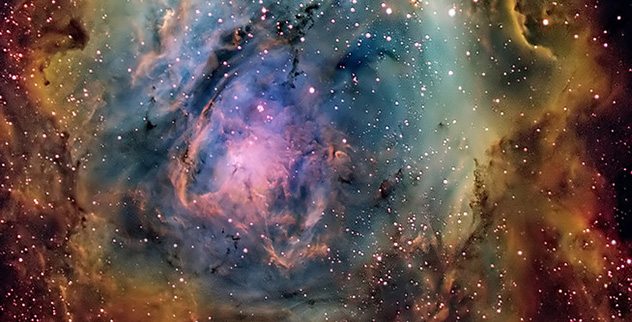
The Lagoon Nebula, Messier 8, is a large star-forming region in Sagittarius. Located several thousand light-years away, it combines glowing gas, dark dust, and a young open cluster. Under an exceptionally dark sky, it may be barely visible without optical aid; binoculars make it much easier to identify.
What Appears in Binoculars
Expect a broad, pale glow embedded in a crowded field of Milky Way stars. The nearby cluster NGC 6530 contributes a grainy, sparkling texture. You will probably not see the intricate colors or sharply divided clouds familiar from long-exposure images, but the combination of nebulosity and starlight is compelling.
The Lagoon’s apparent brightness is spread across a large area. As a result, dark skies matter more than raw magnification. A 7×50 binocular under rural skies may outperform a larger instrument used beneath city lights.
Finding the Lagoon
Look for the Teapot-shaped pattern of Sagittarius on summer evenings. Sweep upward from the Teapot’s spout into the bright Milky Way. The Lagoon appears as one of the region’s most obvious cloudy patches. Continue scanning and you may encounter additional clusters and nebulae nearby.
10. The Hercules Cluster: A Globular Snowball of Ancient Stars
Messier 13, the Great Hercules Cluster, is one of the Northern Hemisphere’s most famous globular clusters. Located about 25,000 light-years away, it contains more than 100,000 stars packed into a roughly spherical swarm.
What Binoculars Can Show
Small binoculars usually present M13 as a compact, round, slightly fuzzy spot. Larger or tripod-mounted models may make the center appear brighter, but resolving individual stars generally requires a telescope. Even unresolved, the cluster looks distinctly different from a normal star.
The real thrill comes from understanding what the glow represents. A globular cluster is an ancient stellar population orbiting the Milky Way. That tiny cotton ball is an immense city of old stars compressed by distance into one luminous bead.
How to Find M13
Locate the Keystone, a four-star pattern forming the central body of Hercules. M13 lies along one side of the Keystone, between two of its corner stars. It is best placed during late spring and summer, with July offering convenient evening views from many northern locations.
Binocular Stargazing Tips That Make Every Target Better
Choose Stability Before Magnification
A steady 8x view often reveals more than a shaky 15x view. Sit in a reclining chair, brace your elbows, lean against a solid surface, or attach larger binoculars to a tripod. Stability improves focus, contrast, and your ability to notice faint details.
Protect Your Night Vision
Avoid bright white lights and phone screens. Human eyes generally need 20 to 30 minutes to adapt well to darkness, and one accidental blast from a flashlight can undo much of that progress. Use a red-light setting and reduce screen brightness before going outside.
Observe Objects More Than Once
Atmospheric clarity, moonlight, humidity, location, and experience all affect what you see. A target that looks unimpressive tonight may be stunning from a darker site or on a more transparent evening. Astronomy rewards repeat visits.
Let Your Eyes Learn
Beginners sometimes expect instant detail. In practice, observing is a skill. Spend several minutes with each object. Relax your gaze, experiment with averted vision, and notice whether faint extensions or additional stars gradually emerge.
Field Experiences: What Binocular Astronomy Really Feels Like
My most memorable binocular sessions have rarely begun with a grand plan. They usually start with a clear evening, a folding chair, and the innocent thought that I will step outside for “just five minutes.” Astronomy has its own definition of five minutes. It is approximately the period between dinner and realizing that midnight has arrived.
The Moon is often the first stop because it requires no navigation. On one particularly clear evening, the terminator crossed a heavily cratered region, and the low sunlight made every rim cast a sharp shadow. The surface no longer resembled a flat gray disk. It looked like a physical placehostile, silent, and close enough to tempt the imagination. Moving the binoculars slightly caused the scene to shake, so I rested my elbows on a fence. The improvement was immediate. Features that had seemed blurry became distinct, proving that the best astronomy accessory was not a new lens but an old wooden railing.
Jupiter provides a different kind of satisfaction. The planet itself is obvious, but the first glimpse of its moons can be confusing. Are those really moons or merely background stars? The answer becomes clear after returning the next evening. The little points have rearranged themselves. A third visit may show one missing behind the planet. Watching that motion creates a direct sense of orbital mechanics that no diagram can duplicate. Jupiter stops being a bright dot and becomes a system.
Deep-sky observing is quieter and requires more patience. The first time someone searches for the Andromeda Galaxy, the expected cinematic spiral often fails to appear. Instead, there is a subdued patch of light that becomes more obvious when viewed slightly off-center. Yet once the distance is understood, the smudge becomes astonishing. You are not failing to see the galaxy. You are successfully seeing light that traveled for millions of years before reaching two small lenses held in your hands.
Star clusters offer the most immediate visual reward. The Pleiades snap into a brilliant arrangement as soon as binoculars reach the eyes. The Double Cluster is even more dramatic under dark skies, where both groups sit amid a background powdered with Milky Way stars. These are the moments when binoculars feel less like magnifying devices and more like hidden-door openers. The sky had always contained those stars; your eyes simply needed help receiving the invitation.
Dark locations also change the character of familiar targets. From a city, the Orion Nebula may look like a small smoky patch. From rural surroundings on a moonless winter night, the same region appears broader and more structured. The Lagoon Nebula benefits even more. Under light pollution it can be frustratingly faint, but beneath a transparent summer sky it emerges among rich fields of Sagittarius stars. Slowly sweeping that region can be more enjoyable than hunting a single object because new clusters and patterns drift into view without warning.
Comfort matters more than beginners expect. Cold hands, neck strain, mosquitoes, and a wobbly stance can end a session faster than poor optics. A reclining chair makes high-altitude targets easier. Warm layers extend winter observations. In summer, insect repellent may contribute more to astronomical success than an expensive eyepiece. The universe is magnificent, but mosquitoes remain aggressively local.
The greatest binocular-stargazing experience is not checking all ten objects off a list. It is reaching the moment when the sky stops looking like a random ceiling of bright points. Taurus gains clusters. Orion gains a stellar nursery. Jupiter gains a family of moons. A faint autumn patch becomes another galaxy. Familiar constellations turn into landmarks, and those landmarks lead to destinations.
That change in perception lasts. After learning the sky through binoculars, you begin looking up even when you have no equipment. You notice Jupiter above a parking lot, recognize the Pleiades through a gap in the clouds, or identify Orion while walking home. The binoculars may be back in the closet, but the universe no longer is.
Conclusion: The Universe Is Closer Than It Looks
Binocular astronomy proves that exploring the night sky does not require a huge telescope, a computerized observatory, or a backyard suspiciously free of trees. A familiar pair of binoculars can reveal ten extraordinary destinations: the Moon’s scarred terrain, Jupiter’s moving moons, the Pleiades and Hyades, the Orion and Lagoon nebulae, the Andromeda Galaxy, the Double Cluster, the Beehive Cluster, and the ancient Hercules Cluster.
Start with the brightest targets, learn a few constellations, and gradually move toward fainter objects. Observe from the darkest safe location available, stabilize the binoculars, and give your eyes time to adapt. Most of all, return often. The objects may be ancient, but changing seasons, lunar phases, atmospheric conditions, and your own improving skills make every session different.
The next clear night, take those forgotten binoculars outside. They have been pretending to be bird-watching equipment long enough.
{"meta_title": "Top 10 Night Sky Objects to See With Binoculars","meta_description": "Discover 10 spectacular night sky objects visible through binoculars, from lunar craters and Jupiter’s moons to nebulae and galaxies.","sapo": "You do not need a complicated telescope to explore the universe. An ordinary pair of binoculars can reveal rugged lunar craters, Jupiter’s four largest moons, glittering open clusters, glowing stellar nurseries, an ancient globular cluster, and even the Andromeda Galaxy millions of light-years away. This in-depth guide introduces ten fabulous night sky objects that look especially rewarding through binoculars, explains when and where to find them, and sets realistic expectations for what you will see. You will also learn practical binocular stargazing techniques, including how to stabilize your view, protect your night vision, use averted vision, choose dark observing locations, and recognize the seasonal landmarks that lead to deep-sky treasures. Whether you are a complete beginner or an experienced observer seeking a convenient wide-field instrument, these targets prove that some of astronomy’s greatest views are available without bulky equipment or a giant budget.","keywords": ["night sky objects","binocular astronomy","stargazing with binoculars","deep-sky objects","binocular stargazing targets","beginner astronomy","objects visible through binoculars"]}</pre