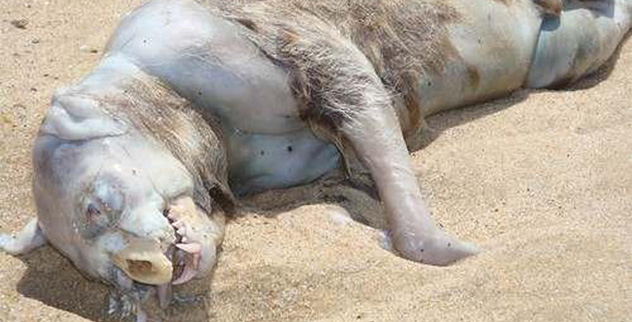

Every so often, the ocean tosses something onto a beach that makes everyone briefly forget how biology works. A pale mound appears in the sand. It has no obvious head, no polite little label, and absolutely no interest in helping humans identify it. Within hours, someone says “sea monster,” someone else says “alien,” and a third person, usually a marine biologist holding coffee and patience, says, “Actually, that is probably a whale.”
Welcome to the strange, salty world of globsters and sea carcasses: mysterious organic masses that wash ashore and look far more dramatic than their scientific explanations. The word “globster” usually refers to an unidentified blob-like carcass that has become too decomposed, distorted, or incomplete for casual observers to recognize. These finds are fascinating because they sit right where folklore, marine biology, forensic science, and beach gossip all collide.
The funniest twist? Most globsters are not monsters at all. They are often whale tissue, decomposed basking sharks, or other known animals transformed by time, currents, sun, saltwater, scavengers, and the internet’s commitment to overreacting. Still, each case tells us something valuable about the ocean: it hides enormous life, recycles death into ecosystems, and occasionally delivers a mystery with the presentation style of a horror movie prop department.
What Is a Globster?
A globster is not a species. It is a mystery category. Think of it as the ocean’s version of an unlabeled container in the back of the fridge: technically organic, deeply suspicious, and best not poked without expert supervision.
Most famous globsters share a few traits. They are large, hard to identify, badly decomposed, and visually misleading. Whale blubber can separate from the rest of the body and appear as a rubbery, fibrous mass. Basking sharks, when decomposed, can lose their familiar shark shape and take on a long-necked “prehistoric reptile” look. Even ordinary land animals can become beach legends after saltwater removes fur and soft tissue.
That is why globsters are so perfect for storytelling. They invite wild theories, but they also reward careful science. Microscopy, DNA testing, anatomy, and chemistry have solved many cases that once sounded like evidence for giant octopuses, sea serpents, or creatures that forgot to appear in biology textbooks.
Top 10 Fascinating Globsters and Sea Carcasses
1. The St. Augustine Monster: Florida’s Famous “Giant Octopus”
The St. Augustine Monster washed ashore near Anastasia Island, Florida, in 1896 and quickly became one of the most famous globsters in history. Early observers thought it might be the remains of a gigantic octopus. That idea was irresistible: Florida beach, enormous mystery mass, tentacle rumors, and just enough uncertainty to make newspapers very happy.
For decades, the case hovered between science and sea-monster speculation. The preserved samples eventually became far more useful than the original guesses. Later analysis showed that the material was not from a giant octopus but from whale tissue, specifically collagen associated with whale blubber. In other words, the “monster” was likely part of a large whale, transformed by decomposition into something that looked stranger than fiction.
Its importance lies in how long it stayed mysterious. The St. Augustine Monster shows why first impressions are risky when dealing with sea carcasses. A badly altered animal can fool smart people, especially when the evidence is incomplete and the imagination is doing push-ups in the background.
2. The Stronsay Beast: A Sea Serpent With Shark Problems
In 1808, a strange carcass washed ashore on Stronsay in Scotland’s Orkney Islands. Witnesses described an enormous animal with a long body and features that seemed to suggest a sea serpent. At the time, naturalists debated whether it might be proof of a previously unknown creature.
The more grounded explanation is that the Stronsay Beast was likely a decomposed basking shark. Basking sharks are huge, harmless plankton feeders, but after death they can become anatomical pranksters. As the head, jaws, gill structures, and soft tissues break down, the remaining body may resemble a long-necked marine reptile. This “pseudo-plesiosaur” effect has confused people more than once.
The Stronsay Beast remains fascinating because it arrived before modern DNA testing, photography, and quick expert analysis. It is a reminder that historical sea monsters often began as real animals seen under confusing conditions. The beast may not have been a serpent, but it absolutely earned its place in globster history.
3. Trunko: The “Hairy” South African Mystery
Trunko is one of the weirdest entries in the globster hall of fame, partly because its story sounds like it was written by someone with a fog machine. Reported near Margate, South Africa, in 1924, the creature was described as a pale, hairy mass associated with dramatic eyewitness claims. Some accounts even described it as looking like a “polar bear” of the sea.
No reliable scientific examination was performed while the carcass was available, which means Trunko remains more uncertain than many other globsters. Later interpretations suggest it may have been a whale-related mass or another large marine animal distorted by decomposition. The “hair” often mentioned in globster stories is usually not hair at all. It can be exposed collagen or muscle fibers that become stringy and fur-like as tissue breaks down.
Trunko is fascinating because it shows what happens when a real carcass meets limited documentation. Without samples, measurements, or expert study, mystery grows like seaweed on a pier. The result is part biology, part folklore, and part “somebody really should have called a scientist.”
4. The Tasmanian Globster: The Blob That Named the Genre
The Tasmanian Globster washed ashore in 1960 and helped inspire the popular use of the term “globster.” It was described as a large, pale, strange-looking mass without an obvious head or typical animal features. If the beach had a comment section, it would have been chaos.
Later analysis indicated that the Tasmanian Globster was whale remains. This fits a pattern seen again and again: large marine mammals can produce large, confusing, blob-like remains after decomposition separates durable connective tissues from more recognizable anatomy.
This case matters because it gave language to a recurring phenomenon. Once people had a word for these mystery masses, it became easier to compare cases across the world. The Tasmanian Globster may not have been a new creature, but it helped define a whole category of marine mystery.
5. The New Zealand Globster: Another Whale in Disguise
In 1965, another mysterious carcass appeared at Muriwai Beach in New Zealand. Like the Tasmanian case, it was difficult to identify at first glance. It had the look of something strange enough to spark rumors but not strange enough to survive scientific scrutiny.
The New Zealand Globster was later identified as a whale carcass. Once again, decomposition had done the heavy lifting. The ocean does not preserve animals for human convenience. It rearranges, strips, floats, sinks, twists, and softens them until familiar creatures look like they were designed by a committee of confused mythmakers.
The New Zealand case is a useful reminder that not every sea carcass mystery needs to be a new species. Sometimes the biggest reveal is that nature’s recycling process is simply very good at disguise.
6. The Zuiyo-maru Carcass: Japan’s “Plesiosaur” Moment
In 1977, the Japanese fishing trawler Zuiyo-maru hauled up a strange carcass near New Zealand. Photographs made it look remarkably like a prehistoric marine reptile: long neck, small head, large flipper-like parts, and a body shape that seemed ready for a museum exhibit titled “Oops, Dinosaurs Are Back.”
The case became internationally famous because the carcass looked so convincing. However, tissue analysis pointed toward a more ordinary but still impressive explanation: a decomposed basking shark. This is one of the classic examples of how sharks can become “pseudo-plesiosaurs” after death.
What makes the Zuiyo-maru carcass so fascinating is not that it fooled people. It is that it fooled people for understandable reasons. A decomposed basking shark really can look shockingly unlike a living basking shark. In this case, the monster was not imaginary; the interpretation was.
7. The Bermuda Blob: Forensics Meets Beach Mystery
The Bermuda Blob appeared in 1988 and became another famous test case for globster science. Like the St. Augustine Monster, it was initially mysterious because it lacked clear anatomy. It was not conveniently shaped like a whale, shark, squid, or anything else recognizable to a beachgoer.
Scientific analysis later linked it to whale remains. The Bermuda Blob helped strengthen the idea that many globsters are not whole animals but pieces or layers of large marine mammals, especially collagen-rich tissue from whales.
The best part of cases like the Bermuda Blob is that they show how unromantic tools can solve romantic mysteries. A microscope may not have the drama of a sea serpent legend, but it has a better track record.
8. The Nantucket Blob: Massachusetts Gets Its Own Sea Mystery
The Nantucket Blob washed ashore in Massachusetts in 1996. It looked strange enough to earn attention, and like many globsters, it raised the usual question: unknown animal, sea monster, or marine leftovers?
Later testing suggested that the Nantucket Blob was adipose tissue from a whale. That may sound less thrilling than “Atlantic mystery beast,” but it is scientifically important. Each solved case adds to the pattern: large whales can produce huge, puzzling remains that do not resemble the original animal by the time they reach land.
The Nantucket Blob also shows how modern science gradually cleaned up the messy archive of monster stories. Older cases relied on sketches and letters. Newer ones could be tested with biochemical and molecular tools. The more evidence scientists gathered, the more the blobs began pointing back to whales.
9. The Chilean Blob: DNA Solves the Case
The Chilean Blob washed ashore in 2003 and became one of the clearest examples of science ending a sea-monster debate. Early reports described a massive, strange organic mass. As usual, speculation arrived quickly and wore dramatic shoes.
This time, scientists had stronger tools. Microscopic, biochemical, and molecular analysis showed that the Chilean Blob was from a sperm whale. DNA evidence matched sperm whale genetic material, and the tissue structure was consistent with whale blubber collagen.
The Chilean Blob is fascinating because it connects old globster lore with modern forensics. It did not just solve one case; it helped confirm that several famous blobs were whale remains. For fans of sea monsters, that may sound disappointing. For fans of marine biology, it is fantastic. A sperm whale is already one of the most extraordinary animals on Earth. It does not need a fake monster upgrade.
10. The Montauk Monster: When the Internet Found a Beach Carcass
The Montauk Monster washed ashore in New York in 2008 and became famous for a very modern reason: the internet saw it and immediately lost its collective mind. Photos spread quickly, and theories ranged from mutant experiments to unknown species.
Experts who studied the image generally leaned toward a much less supernatural answer: a decomposed raccoon or similar land animal altered by water and decay. It was not a classic whale globster, but it belongs on this list because it shows how any unidentified carcass can become a cultural event.
The Montauk Monster is basically a cautionary tale with paws. A familiar animal can become unfamiliar after exposure to seawater. Remove fur, distort the face, change the proportions through decomposition, and suddenly a raccoon can get promoted to “monster” by social media.
Why Globsters Look So Strange
Globsters look bizarre because decomposition does not happen evenly. Some tissues break down quickly, while collagen, cartilage, blubber, and skin-like structures may last longer. Water movement can strip away recognizable features. Scavengers may remove parts. Sun and salt can change texture and color. By the time the remains reach shore, the original animal may be visually scrambled.
Whales are especially good at creating mystery remains because they are enormous. A small piece of a whale can still be the size of a sofa. If that piece is pale, fibrous, and missing bones, it may look less like biology and more like a rejected special effect from a low-budget monster movie.
Basking sharks create a different kind of confusion. As they decompose, their jaws and gill structures can collapse or detach, leaving a shape that resembles a long neck and small head. This is why several “sea serpent” or “plesiosaur” carcasses have later been interpreted as basking sharks.
What Sea Carcasses Teach Us About the Ocean
Sea carcasses are not just curiosities. They are part of the ocean’s food web. When a whale dies and sinks, it can become a whale fall, feeding deep-sea communities for months, years, or even decades. Scavengers, microbes, worms, and other organisms use the carcass as a temporary ecosystem. Death, in the deep sea, can become a crowded buffet with excellent attendance.
When carcasses wash ashore instead of sinking, humans suddenly have to manage them. Authorities may need to document the animal, take samples, determine cause of death if possible, protect the public, and decide whether to bury, tow, move, or leave the remains. A whale on a beach is not just a headline; it is a logistical project with tides.
Globsters also teach humility. The ocean is vast, and many real species remain poorly understood. But mystery should not mean abandoning evidence. The best approach is curiosity with a seatbelt: enjoy the weirdness, then ask what the tissue, bones, DNA, and ecology say.
Experiences and Reflections: Meeting the Mystery Without Losing the Plot
If you ever walk along a beach and see a strange sea carcass, your first reaction may be exactly what history predicts: stop, stare, and whisper something deeply scientific like, “What on earth is that?” That reaction is normal. Humans are pattern-making creatures. When we see an unfamiliar shape, our brains try to match it to something we know. If the shape is large, pale, and vaguely creature-like, the brain may skip “decomposed whale tissue” and jump directly to “ancient sea dragon having a bad day.”
The experience of encountering a globster, even through photos, is powerful because it makes the ocean feel unknown again. Modern life gives us the illusion that everything has been mapped, named, tagged, filmed, and uploaded. Then a mysterious mass appears on a beach, and suddenly the world feels bigger. That feeling is valuable. It is the spark behind science, exploration, and every good museum visit.
But the best globster experience is not just wonder. It is wonder followed by investigation. The smart response is to keep a safe distance, take photos if appropriate, note the location, and report the find to local wildlife or marine mammal authorities. Do not touch it, climb on it, cut souvenirs from it, or let pets near it. Besides being unsafe, disturbing a carcass can destroy evidence scientists need to identify the animal or understand how it died.
For writers, educators, and curious readers, globsters are a gift. They combine mystery, history, biology, and humor in one unforgettable package. You can use them to explain DNA testing, decomposition, marine ecosystems, whale falls, shark anatomy, media hype, and why “I saw it on the internet” is not the same as “case closed.” They are also excellent reminders that reality is already strange enough. A sperm whale, a basking shark, or a deep-sea ecosystem is not boring just because it is real.
In fact, the scientific explanations often make the stories better. A fake sea monster is a dead end. A whale carcass that becomes food for deep-sea organisms opens an entire world of ecological drama. A decomposed basking shark mistaken for a prehistoric reptile reveals how anatomy changes after death. A raccoon turned internet cryptid shows how quickly modern culture can transform a beach discovery into a legend.
The emotional experience is also interesting. People are drawn to globsters because they sit between fear and fascination. They are unsettling but not usually dangerous from a distance. They look like evidence of something hidden, but they often point back to known animals in surprising forms. That balance keeps them memorable. They let us feel the thrill of mystery without needing to invent facts.
So the next time a headline screams about a “mysterious sea monster” washing ashore, enjoy the drama, but bring your skeptical beach towel. Ask whether experts examined it. Ask whether DNA testing was done. Ask whether it could be whale tissue, a shark, a seal, a fish, or a land animal altered by seawater. The truth may not have tentacles, glowing eyes, or a movie franchise, but it will probably be more useful.
Globsters remind us that the ocean is not a tidy aquarium. It is a living, moving, recycling system full of giants, currents, decay, renewal, and surprises. Sometimes it sends us beauty. Sometimes it sends us data. And sometimes it sends us a confusing blob that makes the whole beach say, “Nope,” while scientists quietly reach for sample bags.
Conclusion
The top 10 fascinating globsters and sea carcasses prove that the ocean does not need mythical monsters to be mysterious. From the St. Augustine Monster to the Chilean Blob, from the Stronsay Beast to the Montauk Monster, these cases show how ordinary biology can become extraordinary under the right conditions. Whales, basking sharks, and even raccoons can look unrecognizable after the sea has edited them.
The real lesson is not “sea monsters are fake.” The better lesson is that evidence matters, nature is weird, and the ocean remains one of Earth’s greatest mystery machines. Globsters are strange, funny, educational, and oddly humbling. They turn beaches into classrooms and remind us that science often begins with one simple question: “What is that thing?”