
Some gadgets go out with dignity. Others leave this world with a cut power cord, a missing remote, a suspicious rattle, and the faint smell of “someone tried something.” But every so often, a discarded sound system gets a second chance. That is the wonderfully nerdy spirit behind “Trashed Sound System Lives To Rock Another Day”: a story about repair, curiosity, electronic sleuthing, and the deeply satisfying moment when a piece of “junk” suddenly remembers it was born to shake the furniture.
At first glance, a trashed sound system looks like landfill material. Maybe the remote is gone. Maybe the subwoofer is scratched. Maybe the owner cut the AC cord because the unit made noises that sounded less like music and more like a toaster arguing with a raccoon. But audio gear is often more repairable than it appears. Speakers, amplifiers, connectors, remotes, capacitors, and control boards can fail independently. One broken link does not always mean the whole chain is useless.
This article explores how a discarded speaker system can be rescued, what makes audio repair so rewarding, why e-waste deserves more attention, and how old electronics can still deliver thunderous bass, crisp dialogue, and enough “it works!” joy to make any repair bench feel like a concert stage.
When “Trash” Is Really an Unfinished Repair Project
The star of this kind of story is not just the sound system. It is the mindset. Many people see a broken or incomplete audio system and assume replacement is the only practical option. A repair-minded person sees clues: a missing wired remote, a loose internal connector, a cut cord, an amplifier board that may still be healthy, or a set of speakers waiting for someone patient enough to ask, “What exactly failed here?”
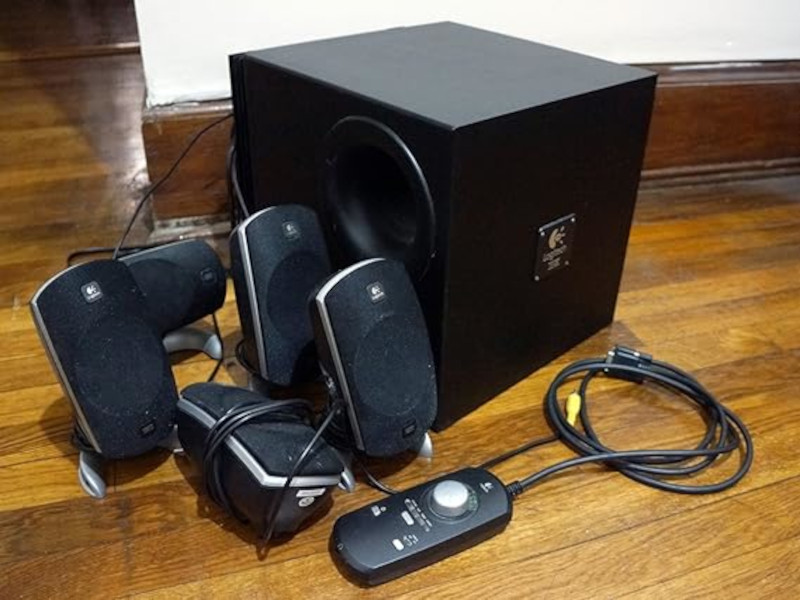
In the case that inspired this topic, the rescued unit was a Logitech Z-5300 surround sound system, or at least the most important chunk of it: the subwoofer cabinet with the amplifier chassis. The original system was designed as a 5.1 computer speaker setup with a powered subwoofer, five satellite speakers, and a SoundTouch wired remote. Without that wired remote, the system was essentially locked out of normal operation. The remote was not a cute accessory; it was the gatekeeper.
That design choice is both clever and annoying. Clever, because it keeps the controls tidy. Annoying, because a perfectly good amplifier and speaker cabinet can become a brick when a small control pod disappears. Anyone who has ever lost a TV remote in the couch cushions understands this pain, except here the couch cushion apparently swallowed the entire user interface.
The Mystery of the Missing Remote
Modern electronics often hide their most important functions behind proprietary connectors, microcontrollers, and specialized control signals. In the Z-5300 system, the wired remote connects through a D-sub style connector and controls power, standby, mute, volume, tone functions, matrix surround, and channel levels. Without it, the system may not wake up, even if the amplifiers are otherwise ready to work.
The repair path started with investigation. Instead of immediately buying a replacement remote and hoping for the best, the repairer studied the connector, looked for documentation, and found online discussion from other audio tinkerers who had reverse engineered parts of the system. The key discovery was that the system used a control chip that could be commanded through an I2C-style interface. In plain English: the amplifier was not dead; it was waiting for the right digital handshake.
That is the magic moment in many repair stories. The device has not failed in a dramatic, movie-explosion way. It is simply trapped behind a missing signal. Give it the correct command, and the “dead” sound system suddenly becomes very interested in doing its job again.
Why Audio Gear Is Worth Saving
Audio equipment is a particularly satisfying repair category because the reward is immediate and emotional. Fix a printer, and it prints a tax form. Useful? Yes. Thrilling? Let’s not get carried away. Fix a sound system, and it fills a room with music. It turns a quiet workbench into a victory lap. The first clean note after a successful repair feels like the machine saying, “Thanks, I still had one more chorus in me.”
There is also a practical reason to save old audio gear: many speaker systems are built around components that remain useful for decades. A wood or MDF speaker cabinet can still work. A transformer can still deliver power. Speaker drivers may be intact even when a control board fails. Amplifier chips, capacitors, connectors, and cables can often be replaced or bypassed. Even when the original design is imperfect, the hardware may still have real value.
In the Z-5300 example, Logitech’s manual listed the system at 280 watts RMS total power, with a 100-watt subwoofer channel and satellite channels making up the rest of the output. Those numbers do not make it a professional arena rig, but for a desk, workshop, gaming station, garage, or small movie setup, that is plenty of “please warn the neighbors before testing the bass” energy.
Step One: Don’t Plug in Mystery Electronics Like a Cowboy
Before we go any further, let’s invite safety to the party. Old electronics can be dangerous, especially powered audio equipment that connects to AC mains. A cut cord, loose connector, overheated component, damaged plug, or swollen capacitor should be treated seriously. This is not the moment to say, “Let’s just see what happens,” while holding the chassis in one hand and a sandwich in the other.
A careful repair starts with inspection. Look for damaged power cords, missing strain relief, burn marks, cracked solder joints, bulging electrolytic capacitors, loose internal wiring, damaged fuses, rust, water exposure, and signs that a previous owner attempted “repairs” using hope and electrical tape. If the unit has been wet, dropped, smoked, or chewed by a pet with engineering ambitions, pause and reassess.
Unplug equipment before servicing it. Do not bypass fuses. Do not defeat polarized or grounded plugs. Do not use frayed cords. If you are not comfortable working around mains voltage, hand the job to a qualified repair technician. A rescued sound system is fun; becoming part of the circuit is not.
Step Two: Diagnose Before Replacing Parts
The best repairs begin with diagnosis, not shopping. Randomly replacing components can work once in a while, but it is usually expensive guessing with a soldering iron. Start by asking what symptom the system has.
No Power
No power may point to a bad cord, blown fuse, failed switch, loose transformer connection, dead standby circuit, missing remote signal, or failed power supply. In the rescued Z-5300 case, the cut line cord and a loose internal AC connection were major clues. Once those physical issues were corrected, the remaining challenge was control, not raw power.
Powers On but No Sound
If a system powers on but stays silent, check mute circuits, input selection, volume control, speaker wiring, headphone jacks, relay protection circuits, and control board communication. In some systems, the amplifier may be healthy while a digital controller refuses to unmute it.
Distorted or Weak Sound
Distortion can come from damaged speaker drivers, failing capacitors, a mismatched amplifier and speaker load, clipping, dirty potentiometers, bad input cables, or a weak power supply. Audio repair is part electronics, part detective work, and part asking, “Why does the left channel sound like it joined a kazoo orchestra?”
Step Three: Understand Speaker and Amplifier Matching
One reason old sound systems fail after being modified is improper speaker matching. Speakers have impedance ratings, commonly 8 ohms, 6 ohms, or 4 ohms. Amplifiers are designed to drive certain loads. If the total impedance is too low, the amplifier may overheat or fail. If it is too high, the amp may not deliver enough power. Either way, the sound suffers, and the repair bench gets another patient.
For surround sound systems, the original satellites are usually designed to work with the original amplifier and crossover behavior. Swapping random speakers can work, but it should be done thoughtfully. Match impedance when possible, avoid overloading the amplifier, and start at low volume. Audio gear is more forgiving than some electronics, but it still appreciates manners.
Power matters too. An underpowered amplifier pushed too hard can clip, producing harsh distortion and heat that may damage speakers. A properly matched amplifier with adequate headroom often sounds cleaner and works less desperately. In other words, volume knobs are not moral challenges. You do not have to turn them all the way to the right just because the knob physically allows it.
The ESP32 Twist: Replacing a Remote With a Brain
The most interesting part of the Z-5300 rescue was the replacement remote. Instead of relying on the original SoundTouch controller, the repairer used a microcontroller approach. An ESP8266 was tested first, then an ESP32 became the better fit thanks to more input/output capability and a color display option.
The new controller could wake the amplifier, mute and unmute it, adjust master volume, trim individual channels, control balance, toggle matrix surround, and remember settings across power cycles. Bluetooth control was added with a simple Android app. Suddenly, a trashed sound system was not merely restored; it had been upgraded with a custom interface. That is repair culture at its best: not just returning a device to factory condition, but making it more personal, flexible, and fun.
There is also a poetic detail: the enclosure for the new control electronics was built from discarded material. A sound system saved from the trash received a controller housed in repurposed plastic. That is not just repair. That is recycling with a punchline.
Why Design Can Make or Break Repairability
This story also highlights a bigger issue in consumer electronics: repairability is often determined long before anything breaks. A product that depends on a proprietary remote, has no service manual, uses glued assemblies, hides critical functions behind undocumented connectors, or makes internal components difficult to access is more likely to be discarded prematurely.
Sometimes companies make these choices for cost, size, aesthetics, or simplicity. But the result can be frustrating. One missing control pod should not condemn a powerful amplifier and speaker cabinet. One loose crimp should not send a system to the landfill. One unavailable part should not turn a repairable product into electronic waste.
This is why right-to-repair discussions matter. Access to manuals, parts, tools, diagnostic information, and reasonable design choices can extend the life of products. For consumers, that means saving money. For repair shops, it means business. For the environment, it means fewer valuable materials buried, burned, or shipped around the world as waste.
The E-Waste Angle: Every Saved Device Counts
Electronics contain metals, plastics, glass, circuit boards, magnets, and other materials that require energy and resources to produce. When electronics are reused, repaired, donated, or properly recycled, those materials stay useful longer. When they are tossed carelessly, communities lose value and may create environmental hazards.
Repair is usually higher on the sustainability ladder than recycling. Recycling is important, especially when a device is truly beyond saving, but reuse keeps the original product intact and useful. A repaired speaker system avoids the need to manufacture, package, ship, and sell a replacement. It also avoids turning a mostly functional device into a pile of separated materials before its time.
That does not mean every broken amplifier should be rescued at all costs. Some repairs are unsafe, uneconomical, or impractical. But many devices deserve at least a diagnosis before disposal. The difference between “trash” and “working system” might be a cord, a connector, a capacitor, a control signal, or a patient afternoon.
How to Bring an Old Sound System Back Responsibly
If you find an old sound system at a curb, thrift store, garage sale, or family basement, approach it like a restoration project rather than a blind gamble. The goal is not just to make noise. The goal is to make safe, reliable, enjoyable noise.
1. Identify the Model
Look for the brand, model number, FCC label, serial plate, or printed circuit board markings. Search for manuals, forum threads, repair guides, and teardown photos. A surprising amount of repair knowledge lives in old forum posts written by people who refused to give up in 2009.
2. Inspect the Power Path
Check the plug, cord, fuse, switch, transformer, and obvious wiring connections. A cut cord should be replaced correctly, not twisted together and wrapped like a low-budget mummy. If the unit uses a detachable power cord, use the proper rated replacement.
3. Check for Missing Control Hardware
Some systems require a remote, control pod, or proprietary cable to work. Before assuming the amplifier is dead, find out whether the missing accessory is essential. Sometimes the “repair” is really a replacement interface.
4. Test Gradually
Use controlled testing whenever possible. Start with low volume, known-good cables, and speakers with the correct impedance. Watch for heat, smell, hum, buzz, smoke, or sudden silence. Smoke is not a diagnostic feature; it is the device filing a complaint.
5. Improve the Setup
Once the system works, placement matters. Surround speakers should generally be positioned around the listening area and angled toward the listener. Subwoofer placement can dramatically affect bass response because room dimensions, furniture, corners, and walls shape low-frequency sound. Move the subwoofer around, test music and movie scenes, and let your ears make the final decision.
What a Rescued Sound System Can Teach Us
The best thing about this story is not that one old Logitech system worked again. The best thing is what it represents. It reminds us that many broken products are not truly finished. They are misunderstood, undocumented, slightly damaged, inconvenient, or missing one small but crucial piece.
Repair also teaches patience. You learn to read symptoms, trace signals, respect safety, search for documentation, and solve problems step by step. You learn that a loose wire can imitate a catastrophic failure. You learn that proprietary design can be annoying but not always unbeatable. You learn that old hardware may still have years of service left when someone cares enough to look closer.
And yes, you learn that “free” projects are often not free. They cost evenings, spare parts, solder, coffee, and the emotional toll of realizing you spent six hours avoiding a $30 used remote. But the result is yours in a way a new purchase never is.
Real-World Experiences: Lessons From Rescuing Trashed Audio Gear
Anyone who has worked with discarded sound systems knows the first rule: the problem is rarely as simple as the seller, donor, or curbside note claims. “Works great, just needs a cable” can mean it needs a cable. It can also mean it needs a cable, a fuse, three capacitors, a remote, two satellite speakers, a small miracle, and a therapist for the person trying to fix it.
One common experience is discovering that the heaviest part of the system is often the most valuable. A powered subwoofer cabinet may contain the transformer, amplifier board, heat sinks, and power supply. Even if the tiny satellite speakers are missing, the subwoofer and amplifier section may still be usable. That makes these systems attractive to hobbyists who want a garage audio setup, a workshop movie system, or a platform for experimentation.
Another familiar lesson is that cables fail more often than people expect. A loose plug, broken strain relief, corroded RCA connector, or damaged speaker lead can create hum, crackle, silence, or intermittent dropouts. Many people discard electronics after hearing ugly noises, but those noises may come from physical connection problems rather than dead circuits. Before condemning the amplifier, wiggle nothing recklessly, but inspect everything carefully.
Capacitors are another classic culprit. In older powered speakers and compact amplifiers, electrolytic capacitors can dry out, bulge, leak, or lose performance. A bad power supply capacitor may cause hum, weak bass, startup problems, or unstable operation. Replacing capacitors requires correct values, voltage ratings, polarity, temperature ratings, and safe handling, but it can bring old gear back from the edge.
Then there is the issue of “flat” versus “fun” sound. Some repaired studio monitors or computer speakers may sound dull at first because they were designed for accuracy rather than exaggerated bass and treble. Other consumer speakers are tuned to sound exciting, with boosted lows and highs that make everything feel bigger. After repair, it helps to judge the system in context. A speaker that sounds boring on a desk may become excellent with better placement. A subwoofer that sounds boomy in a corner may become tight and musical after moving two feet away.
One of the funniest repair experiences is the moment when the device works but looks absolutely ridiculous. A temporary controller hangs from jumper wires. The case is open. The display is taped to the top. The Bluetooth app has one button labeled “LOUD?” because naming things at midnight is dangerous. Yet the system plays. At that moment, appearance is secondary. Function has returned, and the project has crossed from “possible waste of time” into “I am definitely building an enclosure for this.”
Of course, not every rescue ends perfectly. Some amplifiers are too damaged. Some speaker drivers are blown. Some proprietary chips are unobtainable. Some repairs cost more than the system is worth. But even failed repairs teach useful skills: soldering, measurement, diagnosis, wiring, safe disassembly, and knowing when to stop. That last skill is underrated. A smart repairer knows the difference between a noble challenge and a haunted object that wants to eat weekends forever.
The most rewarding rescues are the ones that become part of daily life. A trashed sound system in a garage becomes the soundtrack for woodworking. A repaired subwoofer makes movie night feel theatrical again. A rescued set of speakers turns a spare computer into a music station. The device no longer feels like trash. It feels like a story with volume control.
That is why “Trashed Sound System Lives To Rock Another Day” resonates with so many repair fans. It captures the joy of looking at a discarded object and seeing potential instead of garbage. It celebrates the weird mix of thrift, stubbornness, engineering, and playfulness that keeps old electronics alive. And it proves that sometimes the best sound system is not the newest one in a glossy box. Sometimes it is the one you saved, rebuilt, and proudly turned up just loud enough to announce: rock is not dead, and neither is this thing.
Conclusion: Don’t Count Out the Gear With Battle Scars
A trashed sound system can be more than a broken gadget. It can be a repair lesson, a sustainability win, a custom electronics project, and a very loud reminder that “obsolete” is not always the same as “useless.” The Logitech Z-5300 rescue shows how investigation, documentation, microcontroller creativity, and basic hardware repair can turn discarded audio gear into a working system again.
Before tossing old electronics, consider whether the problem is diagnosable. Before buying new, ask whether repair is possible. Before calling something junk, look for the hidden story: the missing remote, the loose connector, the failed capacitor, the cut cord, or the control signal waiting to be rediscovered. Sometimes, all a sound system needs is one more chance to rock another day.