
Two-year-olds are tiny scientists with snack crumbs in their hair. They test gravity by dropping spoons, study acoustics by banging pot lids, and practice negotiation by saying “mine” with the confidence of a courtroom attorney. The right Montessori toys for 2-year-olds do not need flashing lights, mystery buttons, or a soundtrack that haunts your dreams. They need purpose, simplicity, safety, and enough hands-on discovery to keep a toddler happily busy while building real skills.
Montessori-inspired toys are usually simple, sensory-rich, child-sized, and connected to real life. Instead of doing the work for the child, they invite the child to move, sort, stack, match, pour, carry, climb, create, and try again. Experts in early childhood development often recommend toys that support independence, fine motor control, gross motor movement, language growth, problem-solving, and open-ended play. In parent language: toys that help your child learn without turning your living room into a battery-powered circus.
This guide blends Montessori principles, pediatric toy-safety guidance, and practical recommendations from early childhood educators and child-development experts. The result is a thoughtful list of the best Montessori toys for 2-year-oldsplus real-world tips on choosing, rotating, and using them at home.
What Makes a Toy “Montessori” for a 2-Year-Old?
A Montessori toy is not defined by beige wood alone, though the internet sometimes acts like a toy must look like it was carved by a peaceful Scandinavian forest elf. A good Montessori toy for toddlers usually has a clear purpose, uses natural or durable materials, encourages hands-on exploration, and allows the child to control the activity. It should support concentration rather than overstimulation.
At age two, children are developing independence, coordination, practical life skills, early language, social awareness, and problem-solving. That means the best toys are often beautifully ordinary: blocks, puzzles, child-sized cleaning tools, sorting trays, stacking cups, musical instruments, art materials, and movement toys. The magic is not in the label. The magic is in the child’s active engagement.
How to Choose Safe Montessori Toys for 2-Year-Olds
Safety comes first, because toddlers explore the world with their hands, feet, elbows, and occasionally their mouths. For children under 3, avoid toys with small detachable parts, loose magnets, button batteries, sharp edges, long cords, or pieces that can fit inside a toilet paper tube. Always check the manufacturer’s age recommendation, inspect toys regularly, and supervise activities involving water, climbing, art supplies, or small objects.
Look for sturdy construction, non-toxic finishes, washable materials, and pieces large enough for toddler play. A toy can be “Montessori-inspired” and still be unsafe if it has tiny beads, weak parts, or questionable manufacturing. When in doubt, choose simple, larger, durable toys that can survive being loved, dropped, chewed, sat on, and introduced to applesauce.
18 Best Montessori Toys for 2-Year-Olds
1. Wooden Peg Board Set
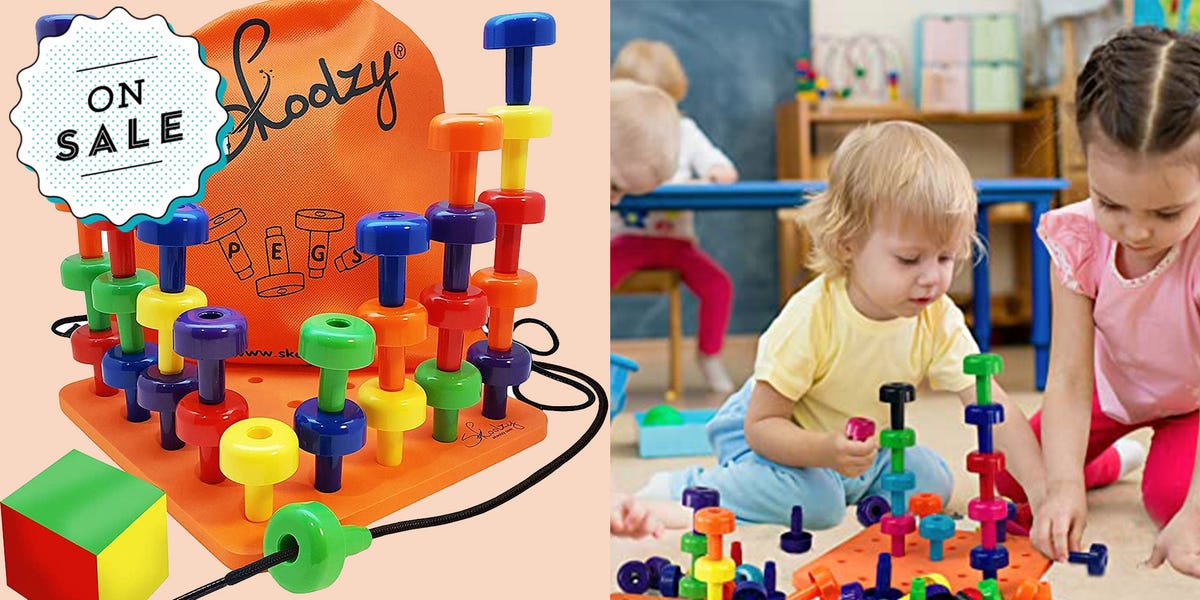
A wooden peg board is one of the most useful Montessori toys for 2-year-olds because it supports hand-eye coordination, color recognition, counting, and early problem-solving. Toddlers can place pegs into holes, sort by color, stack vertically, or create patterns. Choose a set with large pegs that are easy for little hands to grip and too big to be a choking hazard.
2. Chunky Wooden Shape Sorter
Shape sorters help toddlers match circles, squares, triangles, and other basic forms while strengthening spatial awareness. A well-designed sorter gives a child just enough challenge without causing total toddler despair. Look for chunky pieces, smooth edges, and simple shapes. Bonus points if the toy has a quiet design, because your ears deserve nice things too.
3. Object Permanence Box or Coin Drop Box
A drop box teaches cause and effect: object goes in, object comes out, child looks amazed, repeat 47 times. This toy builds concentration, wrist movement, finger control, and problem-solving. For a 2-year-old, choose a version with large wooden coins, balls, or discs. It should be simple enough for independent repetition but sturdy enough to survive enthusiastic scientific testing.
4. Simple Knobbed Puzzle
Knobbed puzzles are excellent for toddlers because they combine visual matching with fine motor practice. Animals, vehicles, shapes, and everyday objects are all good themes. The knobs help children practice the pincer grasp, which later supports writing, dressing, and self-feeding. Start with puzzles that have three to six pieces before moving to more complex boards.
5. Stacking Cups or Nesting Bowls
Stacking cups may look basic, but to a toddler they are engineering equipment. Children can stack, nest, fill, pour, compare sizes, hide objects, and knock towers down with great professional pride. These toys introduce early math concepts such as size, order, volume, and balance. They are also easy to clean, which is not glamorous but deeply important.
6. Wooden Building Blocks
Blocks are classic for a reason. They support creativity, balance, planning, problem-solving, and fine motor development. A 2-year-old may build a tower, a road, a pretend house, or a mysterious structure known only as “no touch.” Choose blocks that are smooth, durable, and large enough for safe toddler use. Open-ended blocks grow with the child for years.
7. Large Lacing Beads
Lacing beads help toddlers develop bilateral coordination, patience, focus, and hand strength. The key word is large. Avoid tiny beads for this age group. Look for oversized wooden beads and a thick lace with a firm end. This toy is best used with supervision, especially at first. It is a quiet, focused activity that can help toddlers slow down and concentrate.
8. Toddler Dressing Frame or Soft Busy Board
A dressing frame or carefully chosen busy board gives toddlers practice with zippers, snaps, buckles, buttons, and Velcro. These are practical life skills in Montessori learning because they help children care for themselves. Choose a board without small detachable pieces, batteries, or sharp hardware. The best version feels like real clothing practice, not a miniature escape room.
9. Child-Sized Cleaning Set
Many 2-year-olds love sweeping, wiping, dusting, and carrying things from one place to another with impressive seriousness. A child-sized broom, mop, dustpan, or cleaning cloth supports independence and practical life learning. It also lets toddlers participate in family routines. Will the floor become cleaner? Maybe. Will your child beam with purpose? Absolutely.
10. Pouring and Transferring Set
A small pitcher, cups, bowls, scoop, and tray can become a powerful Montessori activity. Toddlers can pour water, transfer dry pasta, scoop rice, or move pom-poms with tongs under supervision. These activities build coordination, concentration, wrist control, and confidence. Use larger, safe materials and avoid anything that could be swallowed. Expect spills. Spills are part of the curriculum.
11. Wooden Rainbow Stacker
A rainbow stacker is open-ended and visually inviting. Children can stack arches, make tunnels, build bridges, create animal homes, or use pieces in pretend play. Unlike a toy with one correct answer, this one encourages imagination and flexible thinking. Choose a stable, smooth version with non-toxic paint and pieces large enough for toddler play.
12. Wobble Board
A wobble board supports balance, core strength, body awareness, and open-ended play. It can become a bridge, slide, boat, tunnel, ramp, reading spot, or dramatic stage for stuffed animals who apparently have urgent business. Use it on a safe surface and supervise active play. For movement-loving toddlers, this is one of the most versatile Montessori-inspired toys.
13. Pikler Triangle or Climbing Arch
A Pikler-style climbing toy encourages gross motor development, confidence, coordination, and risk assessment. It allows toddlers to climb at their own pace, which fits well with Montessori respect for child-led exploration. Safety is essential: use proper mats, follow the manufacturer’s age and weight limits, and supervise closely. This toy is best for homes with enough space for safe movement.
14. Push Wagon or Doll Stroller
A sturdy push wagon or doll stroller helps toddlers practice walking, pushing, carrying, and pretend caregiving. It supports gross motor skills and imaginative play without needing lights or sound effects. A good wagon can carry blocks, dolls, books, toy animals, and occasionally one very determined toddler’s entire emotional support rock collection.
15. Wooden Musical Instruments
Simple instruments such as shakers, rhythm sticks, xylophones, hand drums, and bells support listening, rhythm, coordination, and self-expression. Music also helps toddlers connect movement with sound. Choose instruments that are well-made, age-appropriate, and not too loud. Your child gets sensory learning; you keep your sanity. Everyone wins.
16. Play Silks or Sensory Scarves
Play silks are lightweight, open-ended, and wonderful for pretend play. They can become capes, blankets, rivers, picnic cloths, doll carriers, animal beds, or magic clouds. This kind of toy supports creativity, language, movement, and social play. Choose breathable, child-safe fabrics and supervise to prevent unsafe wrapping or rough play.
17. Sorting Trays with Everyday Objects
A sorting tray with large buttons, wooden shapes, fabric squares, toy animals, or color cards encourages classification and early logic. Toddlers can sort by color, size, texture, shape, or category. Keep materials large and safe. The beauty of this toy is that it can change often: one week it is animals, the next week it is leaves, shells, or big wooden shapes.
18. Art Easel with Chunky Crayons and Washable Paint
Art materials support fine motor skills, creativity, sensory exploration, and early mark-making. A toddler easel, chunky crayons, washable paint, and large paper allow children to create while standing, reaching, and moving their arms. Choose non-toxic supplies and expect masterpieces that look like abstract spaghetti. Displaying their art helps build confidence and ownership.
Best Montessori Toy Categories by Skill
For Fine Motor Development
Choose peg boards, knobbed puzzles, lacing beads, dressing frames, stacking cups, and transferring sets. These toys strengthen small hand muscles and coordination. Fine motor skills matter because they support everyday independence, from feeding to dressing to eventually holding a pencil.
For Gross Motor Development
Wobble boards, climbing arches, push wagons, and movement scarves help toddlers build balance, strength, and body awareness. At age two, movement is not a break from learning. Movement is learning. A toddler climbing carefully, pushing a wagon, or balancing on a board is building confidence from the toes up.
For Practical Life Skills
Cleaning sets, pouring pitchers, dressing boards, and child-sized tools are perfect for practical life learning. Montessori education values real tasks because children want to participate in the world around them. A toddler who wipes a table or pours water is not just “playing house.” They are practicing coordination, responsibility, and independence.
For Language and Imagination
Play silks, musical instruments, blocks, animal figures, art materials, and pretend-care toys invite storytelling. At this age, toddlers are learning new words quickly and beginning to narrate their world. Open-ended toys give them something meaningful to talk about, act out, and repeat.
How to Set Up Montessori Toys at Home
You do not need a perfect Montessori playroom with matching baskets and sunlight gently landing on a handmade shelf. A small, organized play area is enough. Place a few toys on a low shelf where your child can see and reach them. Use baskets or trays to keep each activity separate. Too many toys at once can overwhelm a toddler, so rotate items every one to two weeks based on interest.
Try keeping five to eight toys available at a time: one puzzle, one building toy, one practical life activity, one art material, one movement toy, one pretend play item, and one music or sensory activity. This setup helps toddlers focus, choose independently, and clean up more easily. It also prevents the classic living-room disaster known as “every toy has joined the meeting.”
What Experts Look for in Montessori Toys for 2-Year-Olds
Child-development experts often look for toys that are age-appropriate, safe, durable, simple, and engaging. A strong Montessori toy should invite repetition because toddlers learn through doing the same action again and again. It should also give the child control. If the toy performs everything automatically, the child becomes an audience member. Montessori play works best when the child is the main character.
Experts also value toys that connect to real life. Two-year-olds love imitation: sweeping like a parent, cooking like a caregiver, carrying a bag, feeding a doll, or wiping a spill. These tasks build confidence because the child feels useful. In Montessori thinking, independence is not rushed; it is gently supported through the right environment and materials.
Common Mistakes to Avoid When Buying Montessori Toys
The first mistake is buying too many toys. A crowded shelf can make it harder for toddlers to focus. The second mistake is choosing toys that are too advanced. A complicated toy may look impressive online, but if it frustrates your child, it will mostly become expensive shelf decor. The third mistake is assuming “wooden” always means better. A wooden toy with unsafe small parts is still unsafe, while a simple plastic stacking cup can be developmentally excellent.
Another mistake is expecting a toy to teach alone. Toddlers learn best with warm interaction. Sit nearby, name what your child is doing, offer simple language, and then step back. You do not need to turn every play session into a lecture. Sometimes the best teaching phrase is simply, “You did it.”
of Real-Life Experience: What Actually Works With Montessori Toys for 2-Year-Olds
In real homes, Montessori toys work best when they fit the rhythm of family life. A toy can be beautifully designed, expert-approved, and photographed on a perfect shelf, but the true test is whether a 2-year-old returns to it willingly. From experience, the winners are usually the toys that let toddlers do something real with their bodies: carry, pour, stack, wipe, climb, sort, open, close, push, or create.
One of the most successful Montessori-style setups is a simple low shelf with a few trays. On one tray, place a knobbed puzzle. On another, place a small pitcher and cup for pouring practice. Add a basket of blocks, a few play silks, and a child-sized broom nearby. That is enough. Toddlers do not need a toy store in the living room. They need choices they can understand. When the shelf is calm and uncluttered, the child is more likely to choose an activity and stay with it.
Pouring activities are especially powerful, but they require a parent to make peace with spills. At first, use dry materials like large pom-poms or big pasta shapes under close supervision. Later, use a tiny amount of water on a tray with a towel nearby. The towel is not just cleanup equipment; it is part of the lesson. The child learns, “I spilled, and I can help fix it.” That builds responsibility without shame.
Cleaning sets are another surprise favorite. Many adults see sweeping as a chore, but toddlers see it as VIP participation in the household. A child-sized broom or dustpan gives them a way to copy the adults they love. The goal is not a spotless floor. The goal is coordination, pride, and belonging. If three crumbs become seven crumbs during the process, that is simply toddler math.
Movement toys also deserve a place in the rotation. A wobble board or climbing triangle can help a busy toddler regulate energy before sitting for a puzzle or book. Some children need to move before they can focus. That does not mean they are “bad at concentrating.” It means their bodies are part of their learning system. A safe movement option indoors can be a lifesaver on rainy days.
Art supplies should be simple and accessible, but not unlimited unless you enjoy finding crayon murals behind furniture. Chunky crayons, large paper, washable paint, and an easel can create a satisfying creative station. Keep expectations realistic. A 2-year-old is not trying to paint a sunset over the Grand Canyon. They are exploring pressure, motion, color, and cause and effect.
The biggest lesson from using Montessori toys at home is that rotation matters more than quantity. If a child ignores a toy, put it away for two weeks and reintroduce it later. Development changes quickly at this age. The puzzle that caused frustration in March may become the favorite in April. Montessori play is not about forcing milestones. It is about preparing the environment, observing the child, and offering the next gentle challenge.
Final Thoughts
The best Montessori toys for 2-year-olds are simple, safe, purposeful, and inviting. They help toddlers practice independence, coordination, creativity, problem-solving, and practical life skills. A wooden peg board, cleaning set, stacking cups, wobble board, puzzle, or art easel may not look flashy, but these toys give children something better than entertainment: meaningful work disguised as play.
When choosing Montessori toys, focus on what your child can do with the toy, not what the toy can do by itself. The more active the child, the stronger the learning. And if your toddler uses a rainbow stacker as a phone, a bridge, and a hat in the same afternoon, congratulations. That is not chaos. That is innovation with sticky fingers.
Note: This article is based on real Montessori principles, early childhood development guidance, pediatric toy-safety recommendations, and practical parent-tested experience. Always follow product age labels and supervise toddler play, especially with climbing toys, water activities, art supplies, and toys with multiple parts.