
Some paintings feel so alive that you almost expect to hear church bells, smell river water, or get overcharged for coffee at a charming European café. That is the delightful magic behind the idea popularized by The Cultural Tutor: pairing famous paintings with the real-life locations that inspired them. Suddenly, art history stops looking like a quiet museum hallway and starts behaving like a travel itinerary with better lighting.
These famous paintings and their real-life locations reveal something wonderfully human about art. Painters did not merely copy scenery like early cameras wearing berets. They edited reality. They stretched towers, softened rivers, dramatized skies, simplified streets, exaggerated shadows, and occasionally made a humble building look like it had been emotionally preparing for its big Hollywood close-up.
Below is a tour through 30 famous paintings connected to actual places you can still recognize today. Some are nearly unchanged. Some are heavily restored. Some are gone but remembered through reconstruction, scholarship, or the stubborn power of a canvas. Either way, they prove one thing: the world was already photogenic before Instagram discovered saturation sliders.
Why Real-Life Locations Make Famous Paintings More Fascinating
Seeing the location behind a masterpiece changes how we understand the painting. A real place gives us architecture, weather, politics, tourism, and texture. The painting gives us memory, mood, interpretation, and the artist’s slightly bossy opinion about what deserved attention.
That gap between “what was there” and “what the artist made of it” is where the fun begins. Van Gogh could turn a village church into a spiritual thundercloud. Canaletto could make Venice look polished enough to sell postcards before postcards had the decency to exist. Andrew Wyeth could transform a plain Maine farmhouse into one of the loneliest images in American art.
30 Famous Paintings and the Real Places Behind Them
1. The Church at Auvers by Vincent van Gogh Auvers-sur-Oise, France
Van Gogh painted the church at Auvers-sur-Oise in 1890, during his final months north of Paris. The real church still stands, but in the painting it seems to wobble between earth and dream. The deep blue sky, twisting paths, and shadowy structure turn a village landmark into a portrait of spiritual unease. It is less “Sunday service” and more “the building has feelings.”
2. Mont-Saint-Michel by James Webb Normandy, France
James Webb’s 1857 view of Mont-Saint-Michel captures the famous tidal island rising from the water like a medieval castle that learned excellent branding. The real abbey has been a pilgrimage site for centuries, and its dramatic silhouette remains one of France’s most recognizable landmarks. Webb emphasized the vertical drama, proving artists were “enhancing reality” long before tourists discovered wide-angle lenses.
3. El Khasné, Petra by Frederic Edwin Church Petra, Jordan
Frederic Edwin Church painted Petra’s Treasury, also known as Al-Khazneh, in 1874. The real structure is carved directly into rose-colored sandstone, which is frankly showing off. Church’s painting preserves the mystery and scale of a place that had already survived empires, caravans, legends, and now millions of visitors wondering whether they recognize it from movies.
4. American Gothic by Grant Wood Eldon, Iowa
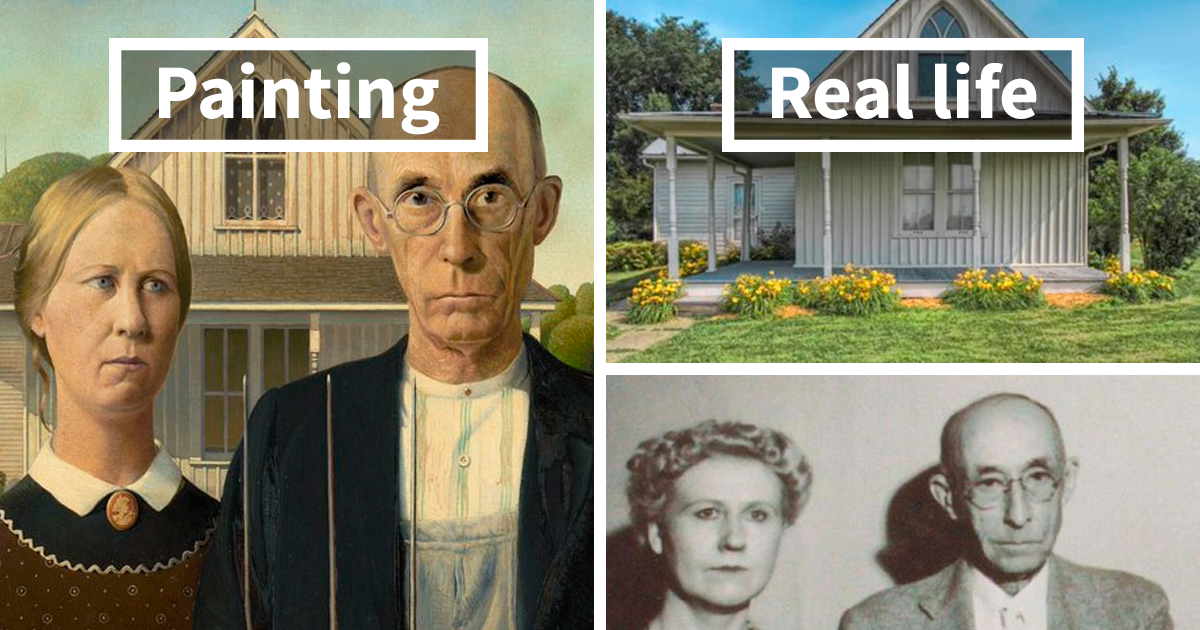
The house behind Grant Wood’s American Gothic is the Dibble House in Eldon, Iowa. Wood noticed its pointed Gothic-style window and built an entire American icon around it. The stern couple in the foreground were not actually the homeowners; they were modeled by Wood’s sister and his dentist. That may be the most Midwestern sentence art history has ever produced.
5. Piazza San Marco by Canaletto Venice, Italy
Canaletto’s Piazza San Marco shows Venice’s grand public square in the 18th century. The real piazza remains astonishingly recognizable, though the Campanile collapsed in 1902 and was rebuilt. Canaletto’s Venice was precise but not passive: he adjusted details to create order, elegance, and a city so beautiful that British travelers wanted to take it home in painted form.
6. Sunrise on the Matterhorn by Albert Bierstadt Swiss Alps
Albert Bierstadt’s Matterhorn is the Alps in heroic mode. The real mountain, straddling the Swiss-Italian border, is already dramatic enough to make other peaks feel underdressed. Bierstadt heightened the effect with glowing light and theatrical scale, creating a mountain that looks less climbed than worshipped.
7. The Night Café by Vincent van Gogh Arles, France
Van Gogh’s The Night Café was inspired by an interior in Arles, where he lived during one of his most intense creative periods. The painting’s tilted room, sharp colors, and lonely tables suggest a place where the coffee is strong, the lighting is suspicious, and nobody is making wise life choices after midnight.
8. High Street, Oxford by J.M.W. Turner Oxford, England
Turner’s High Street, Oxford presents one of Britain’s most beautiful urban views. The architecture remains remarkably familiar, though modern traffic, signs, and crowds have added the usual contemporary garnish. Turner captured the street as a harmony of towers, colleges, and light, reminding us that Oxford has been photogenic since before students started pretending to read in cafés.
9. Palazzo Dario by Claude Monet Venice, Italy
Monet’s Venetian scenes turn stone into color and reflection. Palazzo Dario, facing the Grand Canal, becomes less a building than a shimmering event. The real palace is famous for its elegant façade, but Monet was not interested in architectural paperwork. He painted the sensation of Venice: water, light, and the gentle confusion of beauty refusing to sit still.
10. Christina’s World by Andrew Wyeth Cushing, Maine
The Olson House in Cushing, Maine, inspired Andrew Wyeth’s Christina’s World. The farmhouse still stands, and its quiet presence explains the painting’s emotional pull. Wyeth transformed a real field and house into a vast psychological landscape. The distance between Christina Olson and the home feels larger than geography; it feels like longing with weather.
11. The Little Street by Johannes Vermeer Delft, Netherlands
Vermeer’s The Little Street is tied to Delft, his hometown. Scholars have identified the likely location around Vlamingstraat, where the modest brick façades and domestic calm match the painting’s spirit. It is a masterpiece of stillness: laundry, doorways, children, and daily life made luminous without anyone needing to shout, “Look, I’m historically important!”
12. Interior of St. Peter’s by Giovanni Paolo Panini Vatican City
Panini painted the interior of St. Peter’s Basilica with grand theatrical sweep. The real basilica is already overwhelming, but Panini’s perspective turns it into an architectural opera. He compresses, organizes, and dramatizes space, giving viewers the feeling of standing inside a monument too large for ordinary eyeballs.
13. A Moonlit Night on the Bosphorus by Ivan Aivazovsky Istanbul, Turkey
Aivazovsky’s moonlit Bosphorus places Istanbul in silver-blue atmosphere, with the water acting like a mirror that has read poetry. The real Bosphorus remains one of the world’s most cinematic waterways. Bridges and modern life have changed the skyline, but the essential drama of mosque, moon, and strait still survives.
14. The Doge’s Palace by Claude Monet Venice, Italy
Monet painted the Doge’s Palace as if the building were dissolving into light. The real palace is Gothic, solid, and richly detailed; Monet’s version is vibrating, atmospheric, and almost aquatic. Venice does this to people. You arrive planning to admire architecture and leave describing reflections like a person who owns too many scarves.
15. Interior of the Church of St. Bavo by Pieter Jansz. Saenredam Haarlem, Netherlands
Saenredam was famous for painting church interiors with extraordinary precision. St. Bavo in Haarlem still offers the whitewashed grandeur, columns, and calm that fascinated him. His paintings are so measured that restorers and historians value them as visual documents, though he still used artistic judgment. Accuracy, after all, can wear elegant shoes.
16. The Apse of Notre-Dame by Charles Meryon Paris, France
Meryon’s 1854 etching of Notre-Dame’s apse captures Paris before later changes reshaped the cathedral’s silhouette. The work has added poignancy after the 2019 fire, because it reminds viewers that monuments have many lives. Notre-Dame is not frozen in one century; it is a survivor with better endurance than most of us have after one delayed flight.
17. Café Terrace at Night by Vincent van Gogh Place du Forum, Arles
Van Gogh’s Café Terrace at Night is linked to Place du Forum in Arles. The original site changed over time, and later reconstructions leaned into the painting’s famous yellow glow. Whether viewed as an exact survival or a theatrical echo, the location shows how a painting can turn a café corner into a pilgrimage stop.
18. The Starry Night by Vincent van Gogh Saint-Rémy-de-Provence, France
The Starry Night was inspired by Van Gogh’s view from Saint-Paul-de-Mausole, the asylum in Saint-Rémy where he stayed in 1889. The village and sky are transformed into a cosmic storm of rhythm and emotion. The real place gave him the view; the painting gave the universe a pulse.
19. Starry Night Over the Rhône by Vincent van Gogh Arles, France
This earlier starry scene shows the Rhône River at Arles glowing with gaslight reflections. Unlike The Starry Night, it is more directly tied to a specific riverside view. It is romantic, quiet, and full of luminous dots that make the night look as if someone spilled jewels into the water and decided not to apologize.
20. Water Lilies by Claude Monet Giverny, France
Monet’s water lily paintings grew from the garden he designed at Giverny. He enlarged the pond, planted lilies, and built a Japanese-style bridge, basically creating his own artistic laboratory with frogs. The real garden remains one of the most famous artist sites in the world because it lets visitors walk through the source material.
21. Impression, Sunrise by Claude Monet Le Havre, France
Monet painted Impression, Sunrise from a view over the port of Le Havre. The hazy harbor, orange sun, and quick brushwork helped give Impressionism its name. It is a reminder that one critic’s insult can accidentally become an art movement. Always be careful when mocking painters; they may become a chapter heading.
22. The Hay Wain by John Constable Flatford, England
Constable’s The Hay Wain depicts a rural scene near Flatford on the River Stour. The cottage, river, cart, and clouds form an idealized image of the English countryside. The real location is still associated with “Constable Country,” though the painting’s calm mood politely ignores the harsher realities of rural labor in the early 19th century.
23. Rain, Steam and Speed by J.M.W. Turner Maidenhead Railway Bridge, England
Turner’s train rushes across Brunel’s Maidenhead Railway Bridge over the Thames. The real bridge represented modern engineering; Turner made it feel like weather, technology, and destiny were racing each other. It is one of the great paintings of the Industrial Revolution, and possibly the most dramatic commute in art history.
24. The Scream by Edvard Munch Ekeberg, Oslo, Norway
Munch’s The Scream is associated with a view from Ekeberg overlooking Oslofjord. The real landscape is peaceful, but Munch’s memory of anxiety transformed it into a blazing psychological vision. This is why artists are dangerous in the best way: they can take a nice walk and return with existential thunder.
25. View of Delft by Johannes Vermeer Delft, Netherlands
Vermeer’s View of Delft presents the city from across the water, likely near the Hooikade area. The painting is celebrated for its light, clouds, and calm civic dignity. It makes Delft look like a place where even the bricks have inner lives and everyone speaks softly because the sky is composing itself.
26. The Fighting Temeraire by J.M.W. Turner River Thames, England
Turner’s image of the old warship being towed toward its final berth is based on the Thames and the real HMS Temeraire. The painting is not a literal snapshot; it is a symbolic farewell to an age of sail. Turner makes the sunset do emotional labor, and honestly, it performs beautifully.
27. Nighthawks by Edward Hopper New York City, New York
Hopper said Nighthawks was suggested by a restaurant on New York’s Greenwich Avenue, though the precise location remains debated. The painting is less about an exact diner than the feeling of urban isolation under fluorescent light. It is the patron saint of late-night coffee, emotional distance, and people who say “I’m fine” while staring at pie.
28. Paris Street; Rainy Day by Gustave Caillebotte Place de Dublin, Paris
Caillebotte’s rainy Paris intersection is tied to Place de Dublin in the city’s modernized 19th-century street plan. The wide boulevards, umbrellas, and elegant pedestrians show Paris after Baron Haussmann’s urban transformation. It is a painting where everyone looks stylish despite the weather, which remains deeply suspicious.
29. Bedroom in Arles by Vincent van Gogh The Yellow House, Arles
Van Gogh’s Bedroom in Arles depicts his room in the Yellow House, where he hoped to build an artists’ community. The original building was later damaged and no longer survives as it did, but the painting preserves his dream of rest, friendship, and order. The skewed furniture suggests that peace, for Van Gogh, was both desired and difficult.
30. Wheatfield with Crows by Vincent van Gogh Auvers-sur-Oise, France
Wheatfield with Crows is linked to the fields around Auvers-sur-Oise. It has often been read as ominous because of its dark birds, stormy sky, and road that seems to lead nowhere. Whether or not it was his final painting, it powerfully connects real rural paths with emotional intensity.
What These Locations Teach Us About Art
The best lesson from these real-life locations is that painters are not human photocopiers. They are editors of experience. They choose what to include, what to leave out, and what to exaggerate until reality finally says, “Fine, you win.”
When Webb made Mont-Saint-Michel taller, he was not lying so much as amplifying. When Monet blurred Venice, he was painting the experience of looking, not a building inspection report. When Wyeth set Christina Olson in that wide Maine field, he turned a specific place into a universal image of distance, willpower, and longing.
For travelers, these locations offer a rare double vision. You can stand before the site and see both the physical place and the artistic ghost laid over it. The street is just a street, until Turner appears. The café is just a café, until Van Gogh lights it yellow. The house is just a house, until Wyeth stretches the field and turns silence into narrative.
Experiences Inspired by Famous Paintings and Their Real-Life Locations
Visiting the real-life location behind a famous painting is not the same as visiting a museum. In a museum, the painting is protected, lit, framed, and usually surrounded by people pretending they understand brushwork at a spiritually advanced level. At the real location, the world talks back. Cars pass. Birds interrupt. Someone takes a selfie at the exact angle where a genius once discovered eternity. It is chaotic, but it is also thrilling.
The first experience to expect is surprise. Many locations are smaller, plainer, or more ordinary than the painting makes them seem. The Olson House does not shout for attention. The church at Auvers is not gigantic. A riverside in Arles may look quiet until you remember Van Gogh found enough electricity in it to paint stars like burning coins. That is the point. Great art often begins with ordinary places seen with extraordinary concentration.
The second experience is comparison. Travelers naturally hold the image in their mind and ask, “What changed?” Sometimes the answer is “almost nothing,” as with parts of Oxford High Street or Venetian landmarks. Sometimes the answer is “nearly everything,” as with sites altered by war, development, restoration, or tourism. This comparison turns art viewing into detective work. You look for a window, a roofline, a curve of river, a tower, a hill, or a patch of sky that survived the centuries.
The third experience is humility. A camera may capture the location accurately, but the painting often captures it more meaningfully. That sounds rude to cameras, but they will recover. Stand near a Monet location and you quickly realize that the artist was not merely painting a bridge or palace; he was painting atmosphere. Stand near a Turner site and you feel how motion, weather, and history can collapse into one dramatic moment. Stand in front of a Van Gogh place and you understand that color can be biography.
For the best experience, do a little homework before visiting. Save an image of the painting, learn the artist’s date and context, and note whether the exact viewpoint is known, approximate, reconstructed, or debated. Wear comfortable shoes, because art history has a suspicious habit of involving hills, cobblestones, church steps, and scenic walks that become less romantic after mile three.
Most importantly, do not expect the real place to “beat” the painting. They are partners, not competitors. The location gives the painting its bones; the artist gives it memory, mood, and soul. Seeing both together is like hearing a song and then visiting the room where it was written. The room may be plain. The song is not. Together, they make the past feel reachable.
Conclusion
The fascination behind 30 famous paintings and their real-life locations by The Cultural Tutor lies in the joy of recognition. We discover that art history is not sealed behind museum glass. It spills into streets, rivers, churches, cafés, fields, bridges, gardens, and mountains. These places remind us that masterpieces often begin with someone looking carefully at the world and deciding it deserved more drama, more light, or more emotional honesty.
Whether you are planning an art-inspired trip or simply scrolling from your couch like a cultured potato, these real locations make famous paintings feel newly alive. They prove that the world is full of canvases waiting to happenand that sometimes the most ordinary corner can become immortal when the right artist shows up with paint, patience, and a very intense relationship with the sky.