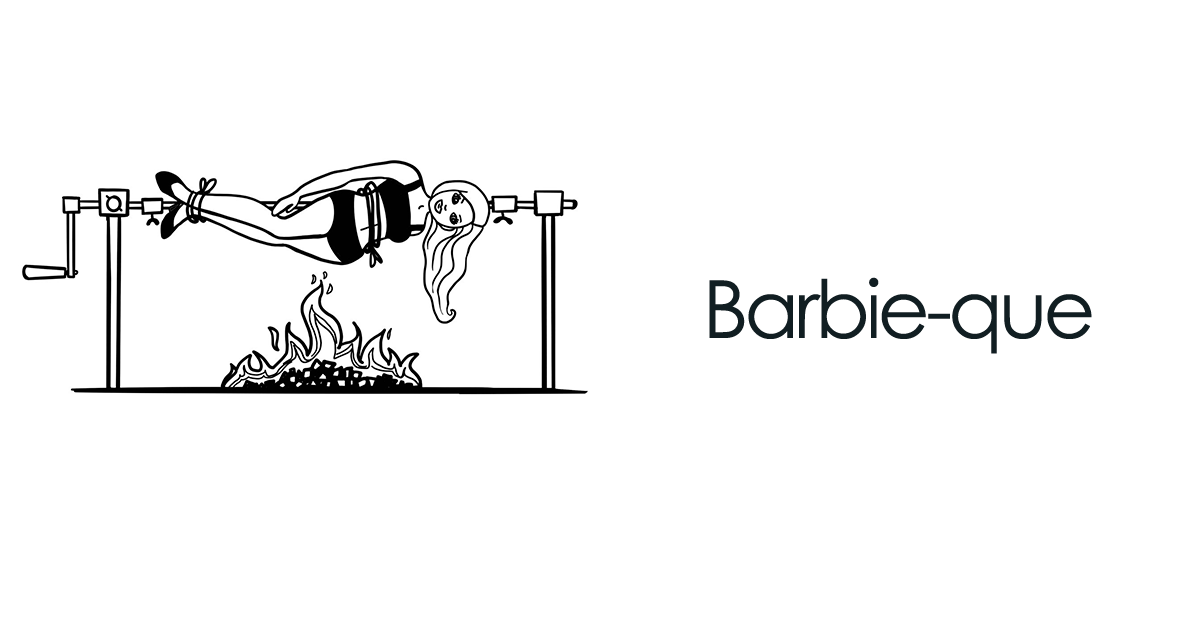
35 Funny Doodles By Nadia Tolstoy That Might Change The Way You Look At Some Words

Some words are so familiar that they practically commute to work in sweatpants. You read them, say them, type them, and move along without noticing that English is full of tiny visual traps. Then Nadia Tolstoy comes along, opens the dictionary’s secret side door, and lets a sea lion stroll through.
Tolstoy’s playful illustrations do not merely tell jokes. They make language physical. A phrase becomes a creature, a compound word gets taken apart like a suspicious sandwich, and an ordinary expression suddenly looks as though it has been hiding a cartoon inside it all along. Her funny doodles invite viewers to pause, squint, groan lovingly at a pun, and wonder why nobody warned them that words could be this weird.
Editor’s note: Nadia Tolstoy is a Stockholm-based cartoonist and illustrator whose ongoing “Surrealians” series combines surreal imagery, puns, and literal interpretations of English words and phrases.
When a Word Stops Behaving Like a Word
The charm of Nadia Tolstoy’s doodles is that they treat language as a box of parts rather than a set of rules. Most people see a word such as “catalog” and think of a booklet, a website menu, or perhaps an overdue library reminder. Tolstoy sees the “cat” in “Cat-A-Log” and gives the word a new life. Suddenly, the term is not a dry organizational tool. It is a feline filing system, probably run by a cat who insists every record be stored under “M” for “Meow.”
That is the essential magic of visual wordplay. The joke begins when the brain notices that a familiar word contains another possible meaning. The drawing then refuses to let that alternative meaning stay hidden. Instead of explaining the pun with a neon sign and three arrows, Tolstoy lets the image do the heavy lifting. The result feels light, quick, and a little absurd in the best possible way.
A pun often works because one sound, spelling, or phrase can point in more than one direction. Visual humor adds a second layer: the viewer has to recognize the word, decode the alternative meaning, and connect the drawing to the language. That tiny sequence is why these doodles feel satisfying. They are miniature puzzles with a punch line.
Why Nadia Tolstoy’s Funny Doodles Feel So Fresh
There are plenty of puns in the world. Some arrive on coffee mugs. Some are printed on T-shirts purchased by relatives who have never met a joke they would not repeat at Thanksgiving. But Tolstoy’s work feels different because the humor is not only verbal. It is visual, surreal, and surprisingly elegant.
Her illustrations usually begin with a simple phrase or word combination. Then she asks the question that makes language nervous: “What would this look like if it were literally true?” A sea lion is no longer just an animal with flippers. It becomes an opportunity to imagine a lion somehow navigating life below the waves, perhaps wondering why its mane keeps floating into its face. A phrase such as bear in mind can turn from an abstract instruction into a bear occupying valuable mental real estate.
That visual shift is small, but it changes the way readers experience everyday language. The words stop feeling like flat labels. They become building blocks, costumes, props, animals, food, and occasionally something that should probably not be allowed near a kitchen appliance.
Minimal Lines, Maximum Mischief
Another reason these wordplay illustrations work is restraint. The joke is often built around one central idea, not a crowded scene shouting for attention. There is no need for elaborate scenery when the main concept is strong enough to carry the laugh. A face lift, for example, does not need a complicated backstory. The phrase already contains a visual suggestion. The artist simply pulls the hidden image out of the language and lets it stand there proudly, probably waiting for applause.
This economy gives the work a doodle-like intimacy. The drawings feel approachable rather than distant or overly polished. They have the energy of a clever idea appearing in the margin of a notebook, except the margin happens to have excellent comedic timing.
35 Doodles, 35 Tiny Language Detours
A collection of 35 Nadia Tolstoy doodles works especially well because one visual pun is amusing, but several in a row change how you read. After the fifth or sixth illustration, viewers begin scanning ordinary words for secret creatures and objects. A restaurant menu becomes suspicious. A road sign starts looking like it is hiding a second meaning. Even a grocery list can feel like an undercover comedy script.
That is where the collection becomes more than a gallery of funny doodles. It turns into a reminder that language is flexible. English is full of compound words, idioms, sound-alikes, double meanings, and phrases that have become so ordinary we forget how strange they are. Consider how often we use expressions like “looking sharp,” “belly laugh,” “shooting star,” “horse radish,” or “onion ring” without imagining their literal versions.
Tolstoy’s illustrations politely interrupt that habit. They ask the viewer to slow down just long enough to notice the ingredients inside the phrase. A shooting star can become a star doing something far more athletic than astronomy normally permits. A belly laugh can turn the body part into an active participant in the joke. An onion ring can become something more formal than a vegetable has any right to be.
It is a small act of rebellion against automatic reading. The doodles suggest that words are not fixed furniture. They are more like old closets: open the door, and you may find a lion in a wetsuit.
The Surreal Side of Everyday English
There is a reason the name “Surrealians” suits this collection. The humor comes from mixing the ordinary with the impossible. A familiar phrase is placed in a world where its literal meaning becomes visible, and suddenly the normal rules of logic take a lunch break.
Surrealism is often associated with dreamlike scenes, strange objects, and unexpected combinations. Tolstoy uses that same sense of surprise on a smaller, friendlier scale. Her work does not demand that viewers decode a mysterious manifesto about reality, identity, or an anxious clock melting over a branch. Instead, it asks a more practical question: What if “sea lion” meant exactly what it sounds like?
The answer is usually delightful nonsense. And delightful nonsense matters. It creates a temporary gap between what we expect and what we see. That gap is where the joke lives. The brain recognizes the phrase, realizes the drawing has taken it somewhere unexpected, and enjoys the small jolt of surprise.
Why the Best Visual Puns Make You Groan First
A good pun rarely receives a neutral reaction. It earns a laugh, an eye roll, a sigh, or the classic response: “That is terrible.” In comedy, “terrible” can be a compliment wearing a fake mustache. The groan is proof that the pun landed.
Tolstoy’s doodles understand this strange law of humor. They are clever enough to make the viewer feel rewarded for getting the joke, but simple enough that the realization arrives quickly. You do not need a lecture in linguistics, a spreadsheet, or a ceremonial robe to enjoy them. You only need a willingness to accept that English has been getting away with a lot.
That is why these illustrations are easy to share. The joke travels well. One person sees the image, understands the phrase, and sends it to another person with a message that says, “This is so dumb.” The other person laughs. Civilization continues.
What These Doodles Teach Us About Creativity
The bigger lesson in Nadia Tolstoy’s work is not that everyone needs to become a cartoonist. It is that creativity often begins by looking at something ordinary from the wrong angle on purpose.
Words are useful because they help us move quickly through the world. We say “deadline,” “bookworm,” “brainstorm,” and “butterfly” without stopping to wonder why those terms sound so dramatic when taken literally. A deadline sounds like a line that has somehow become dangerously decisive. A bookworm suggests a reader with a very unusual diet. A brainstorm sounds less like a meeting and more like weather that requires emergency umbrellas.
The funny doodles in this collection make a case for paying attention to those oddities. Creativity is not always about inventing something from nothing. Sometimes it is about noticing what was already there, sitting quietly inside a word and waiting for someone to give it legs, fins, wings, or a tiny hat.
For writers, teachers, designers, and anyone who has stared at a blank page with the emotional intensity of a Victorian ghost, that is useful advice. Start with a common phrase. Break it apart. Ask what each piece could look like. Follow the weird answer for a minute. You may not create a masterpiece, but you may create something better than another email beginning with “Just circling back.”
How to Enjoy the Collection Without Overthinking It
The best way to experience a gallery of Nadia Tolstoy doodles is not to race through it like you are trying to win a game show. Give each image a second. Read the title. Look at the drawing. Let the tiny connection click into place.
Some jokes will land instantly. Others may take a moment. That is part of the fun. The delay creates a tiny “aha” moment, the mental equivalent of finding a French fry at the bottom of the takeout bag. It was there all along, but now it feels like a personal reward.
You can also use the doodles as a creative exercise. Pick a word you use every day and search for another object, animal, action, or sound hiding inside it. “Sandwich” may contain a suspicious amount of beach activity. “Cupboard” sounds like it should be an athletic event for mugs. “Keyboard” is clearly one letter away from an extremely dramatic piano recital.
The point is not to force a punch line. The point is to notice that language already contains many. Tolstoy simply has the patience and imagination to catch them before they run away.
Extra Experience: What It Feels Like to Start Seeing Words Differently
After spending time with a collection like 35 Funny Doodles By Nadia Tolstoy That Might Change The Way You Look At Some Words, the strange part is not the drawings. The strange part is returning to normal life and discovering that normal life has quietly become a pun factory.
You might be making breakfast and notice that “toast” is one of those words that seems far too cheerful for something that has been browned by heat. You might see a “bookcase” and briefly imagine a detective novel solving a crime inside a piece of furniture. You might hear someone say they are “under the weather” and wonder whether a small cloud is currently charging them rent.
This is the lingering experience of visual wordplay. It trains the mind to notice that familiar phrases are often much stranger than they appear. The words have not changed. You have simply stopped walking past them at full speed.
That shift can make ordinary moments more entertaining. A commute becomes a chance to read billboards for accidental jokes. A shopping trip becomes a scavenger hunt for odd product names. A conversation becomes more playful because one phrase can trigger an unexpected image. The mind starts connecting sounds, meanings, and objects in ways that feel spontaneous rather than forced.
There is also something comforting about that kind of humor. It does not require expensive equipment, a dramatic stage entrance, or a ten-minute explanation from someone who claims the joke “gets better with context.” It begins with attention. A single word can be enough.
That is why funny doodles have such staying power. They are small, but they create a mental afterimage. You may forget the exact linework or the colors of a particular illustration, yet the word itself remains changed. “Sea lion” is no longer only an animal. “Face lift” is no longer only a cosmetic procedure. “Looking sharp” now carries the possibility of pointy danger, and “horse radish” may forever make the produce aisle feel slightly unstable.
For children, this kind of wordplay can make language feel alive instead of intimidating. For adults, it can restore a little of the curiosity that daily routines tend to sand down. There is no age limit on laughing at a phrase that suddenly becomes ridiculous when you picture it literally. In fact, getting older may only increase the value of a joke that arrives in under five seconds and asks nothing more than, “Did you notice that?”
That may be the real appeal of Nadia Tolstoy’s work. Her doodles are not trying to turn every viewer into a pun expert or convince anyone that English is sensible. They simply reveal that language is packed with small openings for surprise. Once you see one, you start seeing more.
And then, eventually, someone says “I need to hit the books,” and you have to leave the room before your imagination pictures a stack of paperbacks filing a police report.
Final Thoughts
Nadia Tolstoy’s funny doodles succeed because they make the familiar unfamiliar again. Her visual puns take ordinary English words, tilt them sideways, and reveal the tiny absurdities hiding inside. The result is not just a set of clever illustrations. It is an invitation to read more slowly, imagine more freely, and laugh at the language we use every day.
The next time you encounter a phrase such as “bear in mind,” “sea lion,” or “face lift,” do not be surprised if your brain pauses for a second and starts drawing. That is the effect of a well-made doodle: it gives a word a new shape, then leaves you unable to unsee it.
Note: This is an original editorial appreciation of Nadia Tolstoy’s visual-wordplay approach. It does not reproduce or replace the artist’s individual illustrations. Research on doodling and recall has produced mixed findings, so the creative value discussed here should not be treated as a productivity or health claim.