
Norwegian last names look simple at first glance: Hansen, Olsen, Larsen, Berg. Easy, right? Then you open one old church record, meet someone named Ole Hansen Berg, and suddenly your family tree starts behaving like a Nordic crime drama. The good news is that Norwegian surnames are wonderfully logical once you know the system. Many are patronymic, meaning they were built from a father’s first name. Others come from farms, valleys, hills, beaches, groves, and other pieces of Norway’s dramatic landscape.
This guide explains the 50 most common Norwegian last names and their meanings in plain American English. You will see why so many names end in -sen, why nature-based surnames like Berg and Lund are so common, and why a Norwegian ancestor may appear under several different names in historical records. Spoiler: they were not necessarily hiding from anyone. They may simply have moved farms.
Why So Many Norwegian Last Names End in “-sen”
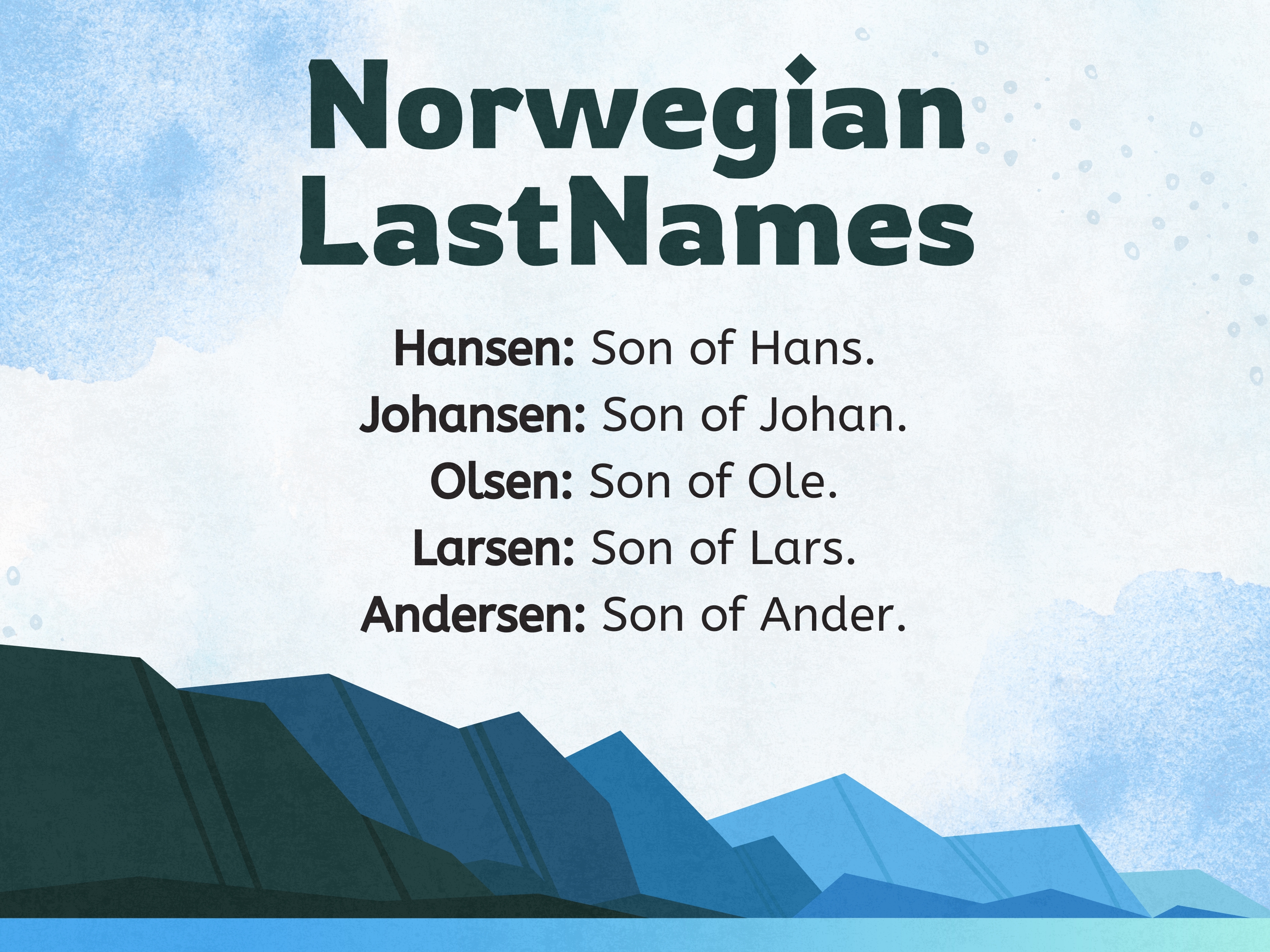
The most common Norwegian surnames are heavily shaped by the old patronymic naming system. In that system, a child’s last name was based on the father’s first name. A son of Hans became Hansen. A son of Ole became Olsen. A daughter of Hans might once have been Hansdatter, meaning “daughter of Hans.” Norway later moved toward fixed family surnames, especially after modern naming laws standardized surname use in the 20th century.
That is why today’s Hansen does not usually mean “this exact person is the son of Hans.” It means the family kept a name that originally meant “son of Hans.” The name became hereditary, like Johnson or Peterson in English. Norway, however, added mountains, valleys, fjords, farms, and enough scenery to make the surname system feel like a travel brochure with paperwork.
How to Read Norwegian Surname Meanings
Norwegian last names usually fall into three broad groups:
1. Patronymic surnames
These are names ending in -sen, meaning “son of.” Examples include Hansen, Johansen, Olsen, Larsen, Andersen, Pedersen, Nilsen, and Eriksen.
2. Farm and place-based surnames
Many families used the name of the farm or place where they lived. Examples include Berg, Dahl, Lund, Strand, Solberg, Eide, Bakke, and Holm. These often describe geography: a hill, valley, shore, island, grove, or slope.
3. Nature and landscape surnames
Some names come from natural features rather than a single family line. These names are especially poetic. A surname like Solberg can mean “sun mountain,” while Lund points to a grove or small forest. Honestly, that is much nicer than being named after a medieval job involving mud.
The 50 Most Common Norwegian Last Names and Their Meanings
The list below reflects widely used Norwegian surname rankings, with meanings based on patronymic roots, Old Norse forms, Norwegian landscape terms, and common Scandinavian name etymology. Exact counts can change by year, but these names consistently appear among Norway’s most familiar family names.
| Rank | Norwegian Last Name | Meaning and Origin |
|---|---|---|
| 1 | Hansen | “Son of Hans.” Hans is a Scandinavian form of Johannes or John, often interpreted as “God is gracious.” |
| 2 | Johansen | “Son of Johan.” Johan is another form of John, with the same “God is gracious” root. |
| 3 | Olsen | “Son of Ole.” Ole is connected to Olaf or Olav, an Old Norse name often linked with ancestral heritage. |
| 4 | Larsen | “Son of Lars.” Lars comes from Laurentius, meaning “from Laurentum” and associated with laurel. |
| 5 | Andersen | “Son of Anders.” Anders is the Scandinavian form of Andrew, meaning “manly” or “brave.” |
| 6 | Nilsen | “Son of Nils.” Nils is a form of Nicholas, meaning “victory of the people.” |
| 7 | Pedersen | “Son of Peder.” Peder is the Scandinavian form of Peter, meaning “rock.” |
| 8 | Jensen | “Son of Jens.” Jens is a Scandinavian form of John, meaning “God is gracious.” |
| 9 | Kristiansen | “Son of Kristian.” Kristian means “Christian” or “follower of Christ.” |
| 10 | Karlsen | “Son of Karl.” Karl means “free man,” related to Charles and Carl. |
| 11 | Johnsen | “Son of John.” A close cousin of Johansen, with the same John/Johannes root. |
| 12 | Pettersen | “Son of Petter.” Petter is another form of Peter, meaning “rock.” |
| 13 | Eriksen | “Son of Erik.” Erik comes from Old Norse elements often interpreted as “ever ruler” or “eternal ruler.” |
| 14 | Berg | Means “mountain,” “rock,” or “hill.” It is one of Norway’s classic landscape surnames. |
| 15 | Haugen | Means “the hill” or “the mound,” from Old Norse and Norwegian landscape vocabulary. |
| 16 | Hagen | Means “the garden,” “enclosure,” or “pasture.” It often referred to a fenced piece of land. |
| 17 | Johannessen | “Son of Johannes.” Johannes is a formal form of John, meaning “God is gracious.” |
| 18 | Jacobsen | “Son of Jacob.” Jacob is traditionally interpreted as “supplanter” or “holder of the heel.” |
| 19 | Andreassen | “Son of Andreas.” Andreas is related to Andrew and means “manly” or “brave.” |
| 20 | Dahl | Means “valley.” It is a common Scandinavian place-name surname. |
| 21 | Halvorsen | “Son of Halvor.” Halvor is related to older Nordic names such as Hallvard, often linked with “rock” and “guardian.” |
| 22 | Lund | Means “grove” or “small forest.” It suggests a family connection to woodland. |
| 23 | Henriksen | “Son of Henrik.” Henrik means “home ruler,” related to Henry. |
| 24 | Jørgensen | “Son of Jørgen.” Jørgen is the Scandinavian form of George, meaning “farmer” or “earth worker.” |
| 25 | Jakobsen | “Son of Jakob.” A spelling variation of Jacobsen, common in Scandinavian records. |
| 26 | Gundersen | “Son of Gunder.” Gunder is related to Old Norse names connected with battle or warriors. |
| 27 | Moen | Means “the meadow,” “moor,” or “open plain.” It is a nature-based farm surname. |
| 28 | Sørensen | “Son of Søren.” Søren is a Scandinavian form of Severin, often associated with “stern” or “serious.” |
| 29 | Iversen | “Son of Iver.” Iver is an old Nordic name often interpreted as “bow warrior” or “yew warrior.” |
| 30 | Svendsen | “Son of Svend” or “son of Svein.” Svein originally meant “young man” or “servant.” |
| 31 | Strand | Means “shore” or “beach.” It often described someone living near water. |
| 32 | Solberg | Means “sun mountain” or “sun hill.” A bright name, literally and emotionally. |
| 33 | Martinsen | “Son of Martin.” Martin comes from Martinus, associated with Mars, the Roman god of war. |
| 34 | Paulsen | “Son of Paul.” Paul comes from Latin Paulus, meaning “small” or “humble.” |
| 35 | Knutsen | “Son of Knut.” Knut is an Old Norse name meaning “knot.” |
| 36 | Eide | Means “isthmus” or “narrow passage between waters.” It is strongly tied to Norwegian geography. |
| 37 | Bakken | Means “the hill” or “the slope.” It usually pointed to a farm or home on rising ground. |
| 38 | Kristoffersen | “Son of Kristoffer.” Kristoffer means “Christ-bearer.” |
| 39 | Mathisen | “Son of Mathias.” Mathias means “gift of God.” |
| 40 | Lie | Means “hillside” or “slope,” from Norwegian li. |
| 41 | Rasmussen | “Son of Rasmus.” Rasmus is a Scandinavian form of Erasmus, meaning “beloved.” |
| 42 | Bakke | Means “hill” or “slope.” Similar to Bakken, but without the definite article. |
| 43 | Amundsen | “Son of Amund.” Amund is an old Nordic given name associated with protection and respect. |
| 44 | Kristensen | “Son of Kristen” or “son of Kristian.” It is another Christian-rooted patronymic surname. |
| 45 | Andresen | “Son of Andres” or “son of Anders.” Like Andersen, it connects to Andrew. |
| 46 | Lunde | Means “grove” or “small woodland.” It is closely related to Lund. |
| 47 | Moe | Means “moor,” “meadow,” or “open land.” It is a short name with deep rural roots. |
| 48 | Berge | Means “mountains” or “hills,” related to Berg. |
| 49 | Holm | Means “small island” or “islet,” often referring to land surrounded by water or marsh. |
| 50 | Fredriksen | “Son of Fredrik.” Fredrik means “peaceful ruler,” related to Frederick. |
What These Norwegian Surnames Reveal About Family History
The first thing you may notice is that the top names are dominated by the -sen ending. This pattern tells a story about families, fathers, and the practical need to identify people in small communities. If a village had three men named Ole, calling one person “Ole, son of Hans” and another “Ole, son of Lars” made everyday life less confusing. It was the original contact list, minus the phone battery anxiety.
The second pattern is geography. Names like Berg, Haugen, Dahl, Lund, Strand, Eide, Bakke, Lie, Holm, and Solberg sound like they belong on a hiking map because many of them do. Norwegian farm names often described the land itself. A family might be associated with the hill, the valley, the shore, the grove, the slope, or the sunny mountain. These names are not random decorations. They are little landscape postcards from the past.
The third pattern is variation. Norwegian records may show alternate spellings such as Jacobsen and Jakobsen, Andersen and Andresen, Kristiansen and Kristensen, or Nilsen and Nielsen. Spelling depended on region, language influence, clerks, migration, and later standardization. When Norwegian immigrants arrived in the United States, names were sometimes simplified, Anglicized, or adjusted to fit English-speaking communities. A name like Johansen might become Johnson, while Pedersen might become Peterson. The family did not change identity; the paperwork changed wardrobe.
Tips for Researching a Norwegian Last Name
Check both patronymic and farm names
If you are researching Norwegian ancestry, do not stop at the surname. A person may appear with a patronymic name in one record and a farm name in another. Someone listed as Ole Hansen in a baptism record might appear as Ole Hansen Berg after moving to or living on the Berg farm.
Look for spelling variations
Norwegian names can include special letters such as ø, æ, and å. In American records, these often became o, ae, or a. Sørensen may appear as Sorensen. Jørgensen may become Jorgensen. Håland may become Haaland. Search creatively, or your ancestor may sit quietly in the archive while you blame the internet.
Remember that “meaning” and “family origin” are not always the same
A surname can have a clear meaning without identifying one exact ancestral location. Berg means mountain or rock, but there are many places called Berg. Likewise, Lund means grove, and Norway has plenty of groves. The meaning gives a clue; documents provide the proof.
Experiences and Real-Life Reflections on Norwegian Last Names
One of the most enjoyable parts of exploring Norwegian last names is discovering how quickly a simple surname turns into a story. A person may begin by saying, “My grandmother was an Olsen,” expecting a neat answer. Then the research opens a door into naming customs, village life, farm movement, church books, migration routes, and the occasional handwriting sample that looks like it was produced during a snowstorm. The experience can be funny, frustrating, and deeply rewarding at the same time.
Imagine tracing a family line and finding a great-great-grandfather named Lars Pedersen. At first, Pedersen feels like the family surname. Then you realize it simply means he was the son of Peder. His own son might not be Pedersen at all. If the son’s name was Anders, and his father was Lars, that son could be Anders Larsen. To modern eyes, it seems like the family changed surnames every generation just to annoy future researchers. In reality, the system made perfect sense in its own time. It identified people by immediate family relationships rather than permanent family brands.
Farm names add another layer of adventure. A Norwegian ancestor might be recorded with a place-based name because that was where the person lived, worked, married, or paid taxes. If the family moved, the name could change. This is why old Norwegian records sometimes feel less like a fixed family tree and more like a travel diary with baptisms. For researchers, the farm name can be a gift. It may point to a specific valley, parish, or rural community. When a surname such as Eide, Bakke, Strand, or Solberg appears, it may hint at the actual landscape your ancestors knew: a narrow crossing, a slope, a shoreline, or a sunlit hill.
For Norwegian Americans, surname research often includes another twist: immigration. When families arrived in the United States, many names were adjusted. Special letters disappeared. Pronunciations shifted. A long patronymic surname might become shorter, and a farm name might become the permanent family name. Some families chose the name that was easiest for English speakers. Others kept the name that felt most connected to home. That is why two relatives from the same Norwegian line may appear under different surnames in American documents.
The best experience comes when the name stops being just a label. Hansen becomes a reminder of Hans. Dahl becomes a valley. Lund becomes a grove. Holm becomes a small island. Solberg becomes a hill catching the sun. These names carry practical information, but they also carry atmosphere. They preserve small pieces of Norwegian daily life: family ties, farms, geography, faith, language, and migration. Researching them is not only about finding names on a chart. It is about learning how people described themselves before surnames became permanent, and how a family’s identity could be shaped by both bloodline and landscape.
Conclusion
The 50 most common Norwegian last names show how closely family, language, and landscape are connected in Norway. Patronymic names such as Hansen, Olsen, Larsen, and Pedersen preserve the old “son of” system. Place-based names such as Berg, Dahl, Lund, Strand, and Holm preserve the hills, valleys, groves, shores, and islands where people lived. Together, they create a naming tradition that is practical, poetic, and occasionally confusing enough to make a genealogist reach for strong coffee.
If you are researching a Norwegian surname, start with its meaning, but keep going. Look for old spellings, farm names, parish records, immigration documents, and regional clues. The name itself may be only the first breadcrumb. Fortunately, in Norwegian genealogy, even the breadcrumbs often come with a mountain view.