
NASA’s Artemis program is often described in heroic, postcard-friendly language: astronauts, moon boots, lunar dust, flags, science, and dramatic helmet reflections. Lovely stuff. But beneath the romance sits a less glamorous truth: the next giant leap may look less like a moonwalk and more like a fuel stop.
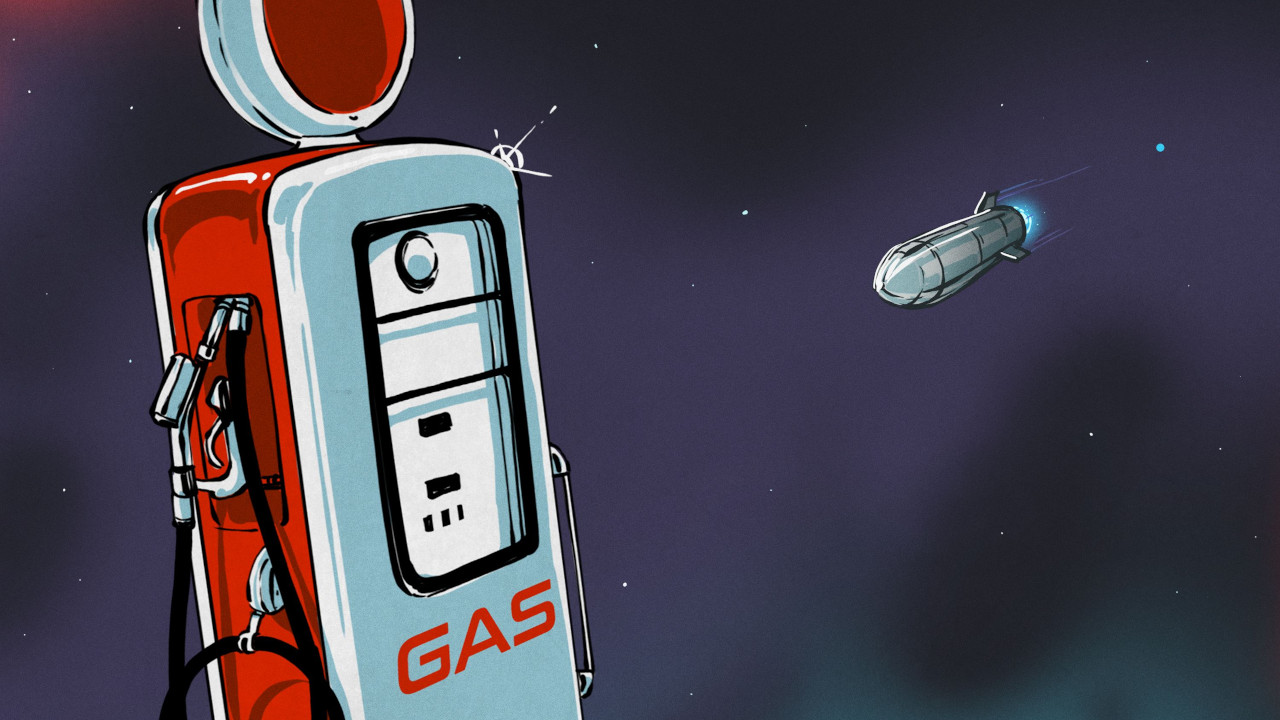
Orbital refueling is the quiet technology that could decide whether Artemis becomes a handful of spectacular missions or a genuine transportation system between Earth, the Moon, and eventually Mars. It is the spaceflight equivalent of inventing the gas station before trying to build the interstate. Without it, lunar landers must launch with nearly everything they need from Earth in one heroic gulp. With it, spacecraft can launch lighter, refuel in orbit, carry more cargo, support longer missions, and return more often. That is not a small upgrade. That is the difference between camping on the Moon and moving into the neighborhood.
The idea sounds simple: send fuel to space, dock two spacecraft, transfer propellant, continue the mission. In practice, it is a ballet performed by giant machines moving at orbital speed while handling cryogenic liquids that are colder than your freezer’s most dramatic dreams. Liquid oxygen, liquid methane, and liquid hydrogen are powerful propellants, but they do not behave like gasoline in a pickup truck. They boil, slosh, stratify, pressurize, cling, and complain. In microgravity, even the basic question “Where is the liquid?” can become a serious engineering puzzle.
Why Artemis Needs Orbital Refueling
Artemis is not Apollo with better computers and sharper publicity photos. Apollo was built for speed, national urgency, and a few short lunar visits. Artemis is meant to support repeatable missions, international crews, commercial landers, lunar science, surface infrastructure, and a long-term path toward Mars. That ambition changes the transportation math.
Getting to the Moon is brutally expensive in energy. A spacecraft must climb out of Earth’s gravity well, accelerate into orbit, depart for the Moon, enter lunar orbit, descend to the surface, ascend again, rendezvous with a crew vehicle, and help bring astronauts safely home. Every maneuver requires propellant. Every pound of propellant requires more rocket to lift it. That extra rocket requires more propellant. Rocket equations are not evil, exactly, but they do have the personality of a loan shark.
Orbital refueling breaks part of that cycle. Instead of launching a fully fueled lunar lander from Earth and asking it to do everything in one shot, Artemis lander architectures can use multiple launches to accumulate propellant in orbit. The crewed mission then proceeds only after the lander has the fuel it needs. This approach adds complexity, but it also opens the door to larger landers, heavier cargo, reusable vehicles, and more flexible mission planning.
The Basic Idea: A Gas Station Above Earth
In ordinary language, orbital refueling means transferring propellant from one spacecraft to another after launch. Sometimes the receiving spacecraft is the mission vehicle. Sometimes the fuel first goes into a depot, a storage vehicle that waits in orbit until the mission vehicle is ready. Either way, the goal is the same: separate the launch of propellant from the launch of crew and mission hardware.
For Artemis, that matters because NASA’s commercial lunar landers are large, capable spacecraft. SpaceX’s Starship Human Landing System is designed to carry astronauts from lunar orbit to the Moon’s surface and back. Blue Origin’s Blue Moon architecture also depends on staged propellant movement and transfer. Both concepts point toward a future in which the Moon is reached not by a single heroic launch, but by coordinated logistics.
That wordlogisticsdoes not sound thrilling until you remember that every serious exploration era has depended on it. Ships crossed oceans because ports, supply chains, maps, maintenance yards, and provisions existed. Railroads opened continents because coal, water, repair depots, and schedules existed. The Moon will not become a practical destination because one rocket is impressive. It will become practical when the supporting system is reliable enough to make missions repeatable.
How SpaceX’s Starship Refueling Plan Fits Artemis
Starship is unusual because it is both a spacecraft and, in operational terms, a very large upper stage. It uses liquid oxygen and liquid methane, and it needs a lot of both. When Starship reaches low Earth orbit, it has already spent much of its propellant getting there. A lunar version cannot simply leave Earth, land on the Moon, lift off, and return to lunar orbit without refueling. The vehicle is big, but physics is bigger. Physics always gets the last laugh, usually in equations.
The Starship lunar concept relies on tanker flights. Tanker Starships would launch to low Earth orbit carrying propellant. They would dock with either a depot Starship or the lunar Starship itself, then transfer fuel. After enough propellant has been aggregated, the lunar lander can depart for the Moon. NASA’s planning and oversight documents have repeatedly identified this vehicle-to-vehicle cryogenic propellant transfer as one of the most important technical milestones for the Human Landing System.
The benefit is enormous. By refueling in orbit, Starship can support a large cabin, cargo capacity, life-support equipment, airlocks, and surface mission hardware that would be hard to fit into a smaller, single-launch lander. The tradeoff is equally clear: it requires a high launch cadence, reliable docking, autonomous operations, thermal control, and transfer hardware that works repeatedly. A lunar mission becomes not one launch, but a campaign.
Blue Moon and the Refueling Trend
Orbital refueling is not only a SpaceX story. Blue Origin’s Blue Moon lander architecture also leans on propellant transfer and staged transportation. The broad direction is unmistakable: lunar exploration is moving toward refuelable systems. Different companies may use different propellants, vehicles, depots, and mission choreography, but the same principle keeps appearing. Launching every ounce of mission propellant in one perfect stack is limiting. Moving fuel through space creates options.
NASA’s decision to work with multiple commercial lunar lander providers reinforces the point. The agency wants redundancy, competition, and a stronger industrial base. If one provider’s vehicle is delayed or one architecture proves harder than expected, another path may mature. That is healthy, but it also means the new lunar era will depend on interfaces, docking standards, mission operations, and the less glamorous art of making complex systems behave together.
Why Cryogenic Refueling Is So Hard
On Earth, fuel transfer benefits from gravity. Open a valve, use a pump, let the liquid settle, and the plumbing usually knows which way is down. In orbit, “down” is mostly a rumor. Cryogenic propellants float, form bubbles, cling to tank walls, and respond to tiny accelerations from pumps, thrusters, thermal gradients, and vehicle motion.
Then there is boiloff. Cryogenic propellants must remain extremely cold to stay liquid. Liquid oxygen is cold. Liquid methane is colder. Liquid hydrogen is the diva of the cryogenic family, requiring especially demanding storage. Heat leaks into tanks through structures, plumbing, sunlight, electronics, and even the gentle insult of time. If propellant warms, it boils. Boiloff can raise pressure, waste mission mass, and complicate storage. Engineers can fight it with insulation, sunshields, active cooling, careful tank design, and pressure-control systems, but none of that is free.
Gauging is another challenge. Knowing how much fuel is in a tank sounds basic, yet in microgravity it can be surprisingly difficult. On Earth, fuel sits at the bottom, and a sensor can estimate quantity by level. In orbit, liquid may be distributed in blobs or sheets. A spacecraft must know how much usable propellant remains before committing to major maneuvers. Guessing is not a mission plan; it is a very expensive way to become famous for the wrong reason.
Finally, there is the transfer itself. Docking ports must align. Valves must seal. Lines must chill down before propellant flows. Pumps or pressure systems must move fluid without creating unstable bubbles or damaging hardware. The spacecraft must manage attitude, loads, thermal conditions, and software coordination. A leak is dangerous. A stuck valve is dangerous. A bad sensor reading is dangerous. Space is beautiful, but it is not forgiving.
NASA’s Technology Demonstrations: Learning Before Betting the Farm
NASA has been investing in cryogenic fluid management because it knows that deep-space exploration needs more than bigger rockets. The agency’s cryogenic fluid management work includes technologies for storing, transferring, and measuring ultra-cold fluids such as liquid hydrogen, liquid oxygen, and liquid methane. Demonstrations like LOXSAT are intended to test key technologies in orbit, including boiloff reduction, propellant transfer, pressure control, and liquid gauging.
These tests may not get the same public attention as crew announcements or launch-day fireballs, but they are foundational. A successful propellant depot or refueling system depends on many small victories: insulation that performs as predicted, sensors that remain trustworthy, valves that open and close cleanly, software that responds to changing tank conditions, and models that match what actually happens in space.
NASA’s Tipping Point investments also show how seriously the agency treats this problem. Industry partners have been selected to demonstrate cryogenic fluid management technologies, including large-scale liquid oxygen transfer, hydrogen storage, and smart cryogenic propulsion systems. These are not science fair side quests. They are the plumbing, thermodynamics, and operations backbone of future lunar and Mars transportation.
The Artemis Schedule Problem
Orbital refueling is exciting because it enables more ambitious missions. It is also stressful because Artemis schedules depend on technology that has not yet been proven at operational scale. Oversight agencies have flagged lander development, cost transparency, launch cadence, vehicle maturity, and cryogenic propellant transfer as major areas to watch.
This does not mean Artemis is doomed. It means Artemis is hard. That distinction matters. Large exploration programs always live in the messy space between ambition and reality. Apollo had failures, redesigns, schedule pressure, and terrifying unknowns. The International Space Station required decades of assembly, diplomacy, redesign, and persistence. Artemis is trying to build a modern lunar transportation system while partnering with commercial providers developing huge new vehicles. Nobody should be shocked that the spreadsheet looks spicy.
The good news is that NASA has adjusted its architecture to test complex operations closer to Earth before committing astronauts to the lunar surface. Low Earth orbit demonstrations allow teams to practice rendezvous, docking, crew operations, and lander interactions in a safer and more recoverable environment. That is the sensible place to learn. If a system has to surprise you, better that it does so a few hundred miles up than near the Moon.
Why Orbital Refueling Could Change Space Economics
If orbital refueling works reliably, its effects will spread beyond Artemis. Refuelable spacecraft can be reused. Depots can support multiple missions. Launch providers can compete to deliver propellant, not just payloads. Cargo missions can carry more useful mass. Scientific spacecraft can gain new mission profiles. Commercial stations, lunar cargo services, and deep-space tugs could all benefit.
Think of aviation. Modern air travel is not built around throwing away the airplane after one flight. It depends on reusable vehicles, maintenance, airports, fueling systems, trained crews, standardized procedures, and predictable turnaround. Spaceflight is not aviation, and pretending it is can get people into trouble. But the analogy is useful in one way: transportation becomes transformative when vehicles are part of a network.
Orbital refueling is one step toward that network. It could make space missions less like one-off expeditions and more like planned routes. The first depots may be crude and expensive. The first transfers may be slow and nerve-racking. But if the system matures, the payoff is enormous: more mission mass, more flexibility, more reuse, and a better chance of making the Moon a working destination rather than an occasional headline.
The Mars Connection
Artemis is often described as a Moon-to-Mars program, and orbital refueling is one of the clearest links between those goals. Mars missions will require long-duration cryogenic storage, large propellant budgets, autonomous operations, and the ability to manage fluids far from Earth. Learning to refuel near Earth and the Moon is a practical rehearsal for much harder missions later.
Mars also raises the possibility of in-situ resource utilization: making propellant from local resources. If future crews can produce oxygen or methane on Mars, refueling becomes part of the return architecture. That is a much bigger challenge than topping off a spacecraft in low Earth orbit, but the lessons overlap. Pumps, valves, storage tanks, sensors, thermal control, autonomy, and safety logic all matter.
In short, Artemis orbital refueling is not just a lunar trick. It is a capability ladder. The first rung is demonstration. The second is operational lunar support. Higher rungs lead toward reusable cislunar vehicles, depots, surface infrastructure, and eventually human missions beyond the Moon.
Conclusion: The Moon Trip Needs a Pit Stop
Orbital refueling may not have the instant visual drama of a rocket launch or a lunar landing, but it may be the technology that makes those moments repeatable. Artemis is trying to do more than revisit Apollo’s footprints. It is trying to build a durable path to the Moon, and durable paths need logistics.
The challenge is real. Cryogenic fluids are difficult to store, difficult to measure, and difficult to transfer in microgravity. The launch cadence required for some architectures is aggressive. The vehicles are still maturing. The mission operations will be complex. Yet the reason engineers keep chasing this capability is simple: without refueling, deep-space transportation remains constrained by what can be launched in a single stack. With refueling, the mission design space expands dramatically.
Artemis’ next giant leap may happen before anyone plants a boot in lunar dust. It may happen when two spacecraft meet above Earth, connect cleanly, chill their lines, open their valves, and move super-cold propellant from one tank to another. It will not look like a moonwalk. It may not even trend for a full day. But if it works, the Moon gets closer, Mars gets less impossible, and the phrase “gas station in space” stops sounding like science fiction and starts sounding like infrastructure.
Experience Notes: Watching the Refueling Revolution from Earth
Following Artemis orbital refueling as a space enthusiast is a strange emotional workout. One moment, it feels obvious: of course spacecraft should refuel in orbit. Cars refuel. Aircraft refuel. Ships refuel. Even your phone refuels, usually at the exact moment you need to leave the house. Then you look at the engineering details and realize this “obvious” idea requires solving a stack of problems that would make a normal machine shop quietly lock the door and go home.
The most interesting experience is how orbital refueling changes the way people think about space missions. For decades, public attention has centered on the rocket. Bigger rocket, louder rocket, more flames, better camera angle. Orbital refueling shifts the conversation from launch power to transportation architecture. Suddenly the important question is not only “Can it launch?” but “Can it come back, launch again, dock, transfer fuel, store fuel, and do it all on a schedule?” That is a more mature question. It is less fireworks, more freight network.
It also makes Artemis feel more industrial. That is not a criticism. In fact, it is exciting. The Apollo era had a heroic minimalism: build the machine, launch the crew, land, return, celebrate, repeat a few times, stop. Artemis, at its best, feels like the beginning of a working system. There will be tankers, depots, landers, crew vehicles, cargo flights, spacesuits, rovers, habitats, communications links, and surface power. The Moon becomes not a stunt location, but a place with supply chains. A dusty, radiation-blasted, airless place, yesbut a place.
The hardest part to appreciate from the ground is patience. Space fans love milestones, and refueling milestones can be maddeningly technical. A launch scrub is visible. A booster catch is spectacular. A lunar landing is cinematic. But a successful test of tank pressure control or propellant gauging may look like a line in a press release. Yet that line may represent years of design work, test campaigns, thermal modeling, software validation, and engineering arguments conducted over coffee strong enough to qualify as rocket fuel.
There is also a useful humility in the topic. Orbital refueling reminds us that space exploration is not conquered by slogans. It is conquered by valves that seal, sensors that tell the truth, software that behaves, teams that rehearse, and managers who respect risk. Big dreams need tiny parts to work. If one coupling freezes, one pressure reading drifts, or one launch cadence slips, the grand architecture has to adapt.
That is why Artemis’ refueling effort is so compelling. It is not merely about getting astronauts back to the Moon. It is about learning how to operate beyond Earth with the repeatability that exploration has always needed. The first successful large-scale orbital refueling campaign may not produce the most glamorous photograph in NASA history. But years later, when lunar cargo arrives regularly or a Mars vehicle is being prepared in orbit, people may look back and realize the future did not begin with a footprint. It began with a fill-up.