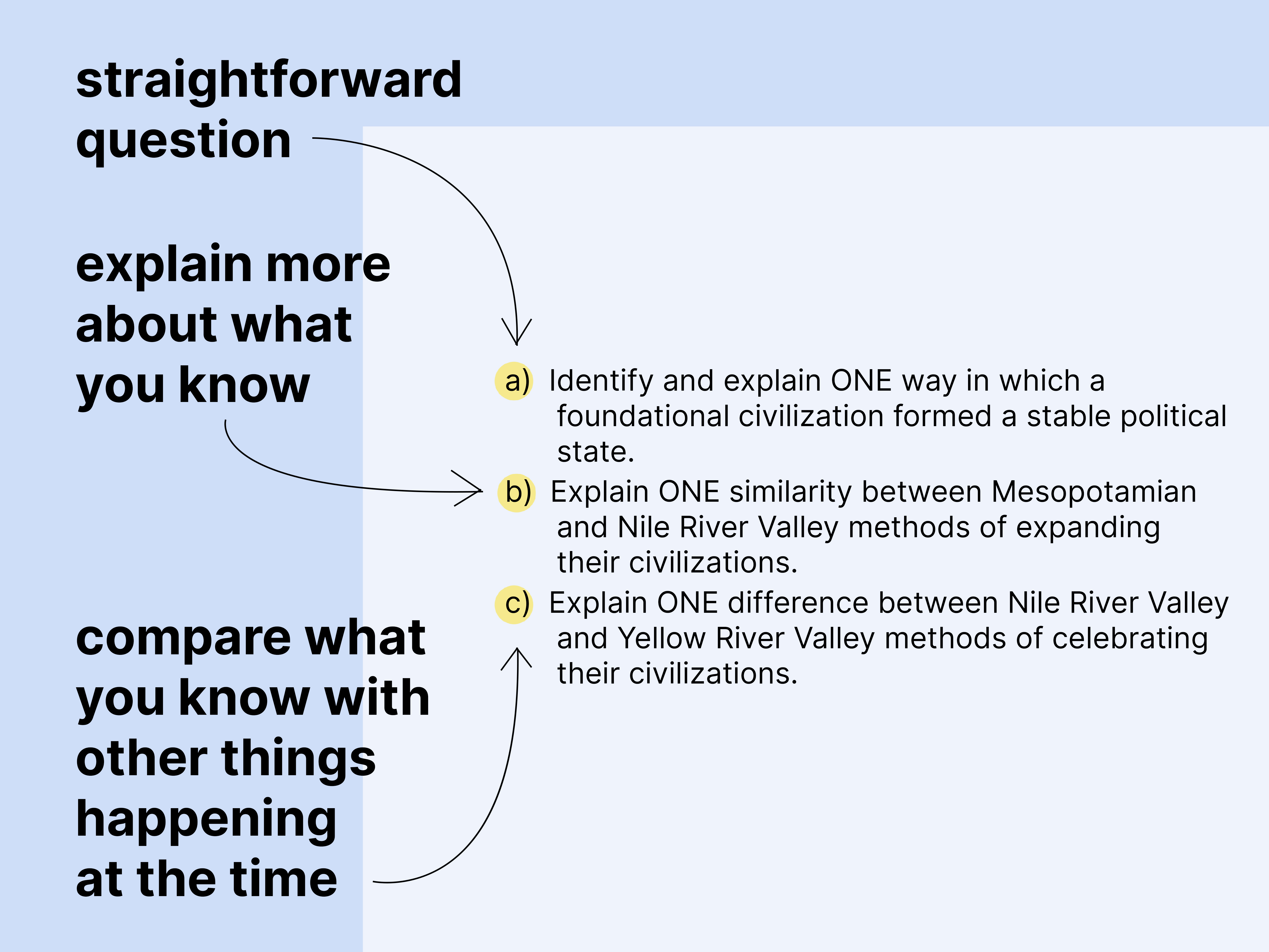

Short-answer questions, better known as SAQs, are the part of the AP History exam where students often think, “Great, short answers! This should be easy.” Then the prompt arrives with three tiny parts, a mysterious historical excerpt, and a clock that seems to have been trained by Olympic sprinters. The good news? SAQs are not meant to be beautiful essays. They are meant to be clear, specific, historically accurate responses that earn points efficiently.
Whether you are taking AP U.S. History, AP World History: Modern, or AP European History, learning how to write an SAQ can seriously improve your score. The SAQ section usually asks you to answer three short-answer questions in 40 minutes, and it counts for a meaningful chunk of your exam score. That means you do not have time to wander through history like a tourist with a map upside down. You need a plan.
This guide breaks down how to write an SAQ using eight practical tips, real examples, and test-day strategies that help you answer faster, sharper, and with fewer panic snacks.
What Is an SAQ on an AP History Test?
An SAQ is a short-answer question designed to test your historical thinking skills. Instead of writing a full essay with an introduction, thesis, and conclusion, you answer separate partsusually labeled A, B, and C. Each part is typically worth one point, so a full SAQ is commonly worth three points.
Most SAQ prompts ask you to do one or more of the following: identify a historical development, explain a cause or effect, compare two ideas, describe a difference between interpretations, or support a claim with evidence. Some SAQs include a stimulus, such as a quote, image, map, chart, or historian’s interpretation. Others are “no stimulus” questions that rely on your knowledge of the course.
The biggest mistake students make is treating an SAQ like a tiny DBQ or LEQ. Please do not. An SAQ is more like a well-packed suitcase: compact, organized, and containing exactly what you needno extra waffle iron.
How to Write an SAQ: The ACE Method
The easiest way to remember the structure of a strong SAQ response is the ACE method:
- A Answer the question directly.
- C Cite specific historical evidence.
- E Explain how that evidence proves your answer.
For example, if a prompt asks you to explain one cause of industrial growth in the United States after the Civil War, a weak response might say: “Technology helped industry grow.” That is true, but it is too vague. A stronger SAQ response would say: “One cause of industrial growth after the Civil War was the expansion of railroads. Railroads connected raw materials, factories, and national markets, allowing companies such as Carnegie Steel to move goods more efficiently and grow rapidly.”
Notice the difference. The stronger answer names a specific development, gives evidence, and explains why it matters. That is SAQ gold.
8 Tips to ACE Your AP History SAQ
1. Read the Prompt Like a Detective, Not a Daydreamer
Before writing anything, slow down for a few seconds and identify exactly what each part of the SAQ is asking. Look for command words such as “identify,” “describe,” “explain,” “compare,” “support,” or “refute.” These words are not decorations. They tell you what kind of answer earns the point.
If the prompt says “identify,” you may only need to name a specific event, process, person, or policy. If it says “explain,” you need to show a relationshipcause and effect, similarity and difference, or evidence and argument. If it says “support,” you must use evidence that clearly backs up the statement or interpretation.
Also pay close attention to the time period. If the prompt asks about 1848 to 1898, evidence from 1803 may be interesting, but it probably will not earn the point. The AP exam is not impressed by random historical trivia. It wants relevant historical evidence inside the requested frame.
2. Answer Each Part Separately
Label your responses A, B, and C. This makes your answer easier to read and helps you stay organized. AP readers score thousands of responses, so clarity is your friend. Do not make the reader hunt for your answer like it is hidden treasure in a pirate movie.
Each part of the SAQ is usually scored independently. That means you can miss Part A and still earn points for Parts B and C. It also means you should not write one giant paragraph and hope all the pieces are floating around in there somewhere. Keep the parts separate and direct.
A clean format looks like this:
A. One major difference between the two interpretations is…
B. One historical development that supports the first interpretation is…
C. One historical development that supports the second interpretation is…
This structure is simple, but simple is not bad. On a timed exam, simple is beautiful.
3. Use Specific Historical Evidence
Specific evidence is the engine of a strong SAQ. Vague answers often sound like they know history but do not prove it. For example, saying “people wanted rights” is weaker than saying “the Declaration of the Rights of Man and of the Citizen reflected Enlightenment ideas about natural rights during the French Revolution.”
Good evidence can include laws, wars, movements, inventions, economic systems, social changes, political parties, court cases, religious movements, or named historical figures. The key is that your evidence must fit the question and the time period.
Here are examples of stronger evidence choices:
- Instead of “reform,” write “the Seneca Falls Convention of 1848.”
- Instead of “imperialism,” write “the British colonization of India.”
- Instead of “religious conflict,” write “the Thirty Years’ War.”
- Instead of “civil rights,” write “the Montgomery Bus Boycott.”
The SAQ does not require you to dump your entire notebook onto the page. It rewards accurate, relevant evidence used with purpose.
4. Explain the “So What?”
Many students lose points because they stop after naming evidence. Evidence alone is not always enough. You need to explain how that evidence answers the question.
Think of your explanation as the bridge between your fact and your point. If you write, “The cotton gin increased cotton production,” that is evidence. If you add, “which expanded plantation agriculture and increased the demand for enslaved labor in the South,” you have explained the historical significance.
That second part is where the point often lives.
A helpful sentence starter is: “This shows that…” For example: “This shows that technological innovation could strengthen existing labor systems rather than automatically create social progress.” That sentence does not just name history; it interprets history.
5. Keep It Short, But Not Empty
SAQ stands for short-answer question, not “say almost nothing and hope for the best.” A strong response is usually two to four sentences per part, depending on the prompt. You do not need an introduction, thesis paragraph, or conclusion. You do need complete sentences and enough detail to earn the point.
A good rule: write one sentence that directly answers the prompt, then one sentence that provides and explains evidence. For harder prompts, add a third sentence to clarify your reasoning.
Weak response:
“The New Deal helped people.”
Stronger response:
“One way the New Deal changed the role of the federal government was by expanding federal responsibility for economic relief. Programs such as the Works Progress Administration provided jobs for unemployed Americans, showing that the government took a more active role in stabilizing the economy during the Great Depression.”
The second answer is still short, but it actually gives the reader something to score.
6. Manage Your Time Like It Owes You Money
The SAQ section moves quickly. With three questions in 40 minutes, you have roughly 13 minutes per question. That includes reading, thinking, planning, and writing. Spend too long on one part, and the next SAQ may stare at you from the page with deep disappointment.
A smart time plan looks like this:
- 1–2 minutes: Read the prompt and identify what each part asks.
- 1 minute: Choose evidence for A, B, and C.
- 8–10 minutes: Write clear, complete answers.
- 1 minute: Check that every part has evidence and explanation.
If you get stuck, do not freeze. Move to the part you can answer. Because points are usually earned independently, a strong Part B can still help your score even if Part A made your brain briefly leave the building.
7. Match the Historical Thinking Skill
AP History SAQs are not just asking, “Do you remember stuff?” They are asking whether you can think historically. That means you may need to show comparison, causation, continuity and change over time, or interpretation of evidence.
If the prompt asks for a cause, do not write only about an effect. If it asks for a similarity, do not write only about differences. If it asks how a source reflects a point of view, do not summarize the source like a book report. Match your response to the thinking skill.
For example, if an AP World History SAQ asks for one similarity between the Ottoman and Mughal empires, a strong answer might discuss how both used religious diversity management to govern large populations. If the prompt asks for a difference, you need to shift gears and explain something that separates them, such as different relationships with religious elites or different regional challenges.
The prompt is the recipe. Do not bake a cake when it asked for tacos.
8. Practice With Real Scoring Guidelines
One of the best ways to improve your SAQ score is to practice with released AP questions and compare your answers to scoring guidelines and sample responses. This helps you see what earns points and what sounds good but misses the target.
When reviewing your practice answers, ask three questions:
- Did I directly answer the prompt?
- Did I use specific, accurate historical evidence?
- Did I explain how my evidence supports my answer?
If the answer to any of those is “kind of,” revise. “Kind of” is not a scoring strategy. It is a warning light.
Common SAQ Mistakes to Avoid
Writing an Essay Instead of an SAQ
You do not need a thesis or long introduction for an SAQ. Save your essay muscles for the DBQ and LEQ. In the SAQ section, direct answers win.
Using Evidence Outside the Time Period
Even accurate evidence can fail if it does not fit the prompt’s date range. Always check the years before choosing your example.
Repeating the Prompt Without Adding Meaning
Restating the question is not the same as answering it. If the prompt asks why reform movements grew, writing “reform movements grew because people wanted reform” is a historical circle, not an explanation.
Being Too Vague
Words like “things,” “stuff,” “people,” “society,” and “bad conditions” are usually too broad. Replace them with named evidence and clear historical language.
AP History SAQ Example: Before and After
Prompt: Briefly explain one way the Market Revolution changed American society in the early nineteenth century.
Weak answer: “The Market Revolution changed the economy and made things different for workers.”
Stronger answer: “One way the Market Revolution changed American society was by increasing wage labor in northern cities. The growth of factories, textile mills, and transportation networks created more jobs outside the home, which shifted many workers away from small-scale household production and toward paid labor in a market economy.”
The stronger answer works because it directly answers the prompt, gives specific evidence, and explains the change. It does not try to sound fancy. It tries to score.
How to Study for SAQs Before Test Day
SAQ preparation should focus on both content and skill. You need historical knowledge, but you also need to practice turning that knowledge into short, point-earning answers.
Start by creating quick evidence banks for major AP History themes: migration, empire, revolution, reform, labor, technology, religion, environment, globalization, and state power. For each theme, list five to ten specific examples. Then practice connecting those examples to causes, effects, similarities, differences, and changes over time.
For AP U.S. History, you might build evidence banks around Reconstruction, westward expansion, industrialization, Progressivism, the New Deal, the Cold War, and civil rights. For AP World History, focus on networks of exchange, land-based empires, maritime empires, revolutions, industrialization, imperialism, global conflict, and decolonization. For AP European History, organize examples around the Renaissance, Reformation, absolutism, Enlightenment, French Revolution, industrialization, nationalism, imperialism, and twentieth-century conflict.
Then practice writing timed responses. Give yourself 13 minutes for one SAQ. When time is up, stop. Review your answer honestly. Did you earn all three points, or did one part rely on “vibes and vocabulary”? Fix it, then try another.
Experience-Based Advice: What Actually Helps Students Improve
After working through many SAQ-style responses, one pattern becomes obvious: students usually do not fail because they know zero history. They fail because their answers are too foggy. They remember the Civil War, the Enlightenment, industrialization, or imperialism, but they do not connect the fact to the exact wording of the prompt. The exam rewards precision, not emotional closeness to the material.
A useful habit is to underline three things before writing: the task word, the topic, and the time period. For example, in the prompt “Briefly explain one effect of industrialization on global migration from 1750 to 1900,” the task is “explain,” the topic is “effect of industrialization on global migration,” and the time period is “1750 to 1900.” That quick breakdown prevents the classic mistake of writing a beautiful answer about industrial technology that says nothing about migration.
Another experience-tested strategy is to prepare “flexible evidence.” These are examples that can be used for several types of prompts. The Meiji Restoration, for instance, can help answer questions about modernization, state power, industrialization, imperial competition, and Western influence. The New Deal can support answers about federal power, economic crisis, reform, political realignment, and the role of government. The Protestant Reformation can work for questions about religious change, political authority, printing, conflict, and challenges to institutions.
Students also improve faster when they stop trying to sound academic and start trying to be clear. You do not need to write, “The aforementioned sociopolitical development catalyzed multifaceted transformations.” You can write, “The policy expanded federal power because it gave the national government a larger role in regulating the economy.” That second sentence is cleaner, faster, and more likely to earn the point.
One of the best practice methods is the “one-minute evidence drill.” Choose a unit, set a timer for one minute, and write as many specific examples as possible. Then pick three examples and explain what each one could prove. This trains your brain to retrieve useful evidence quickly, which is exactly what you need during the SAQ section.
On test day, confidence comes from routine. Label A, B, and C. Answer the question in the first sentence. Use specific evidence. Explain the connection. Move on. If one part feels impossible, write the best historically defensible response you can and keep going. The SAQ section does not require perfection. It requires enough accurate, relevant answers to collect points before the clock runs out.
The real secret is this: AP History readers are not looking for poetic genius. They are looking for a direct answer, supported by evidence, explained clearly. Give them that, and your SAQ score can rise dramatically.
Conclusion
Learning how to write an SAQ is one of the highest-value skills for any AP History student. The format is short, but the strategy matters. Read the prompt carefully, label each part, use the ACE method, choose specific evidence, explain your reasoning, and watch the clock. Do not write a mini essay. Do not wander outside the time period. Do not assume the reader will understand what you meant. Say it clearly.
If you practice with real AP-style prompts and scoring guidelines, SAQs become less scary and more predictable. They are not random traps. They are structured opportunities to show that you can think like a historian under pressure. And yes, you can absolutely get better at them. Your future AP score will thank you, possibly with a tiny academic fist bump.