‘It’s Always Sunny in Philadelphia’ Reveals the Original, Braindead, Paddy’s Pub Business Plan

For two decades, Paddy’s Pub has operated according to one dependable management principle: Whenever a sensible decision appears, chase it out of the building with a broom.
The famously unsuccessful Philadelphia dive bar has survived terrible promotions, hostile employees, disappearing customers, financial disasters, internal coups, questionable renovations and enough abandoned schemes to fill an MBA textbook titled Please Do the Opposite. Yet Season 17 of It’s Always Sunny in Philadelphia reveals that Mac, Charlie and Dennis never viewed Paddy’s as a grubby neighborhood failure. In their minds, it was an unfinished empire.
In “Frank Is in a Coma,” the trio explains that Paddy’s was supposedly intended to become a global branda “Starbucks for dive bars” capable of spreading its sticky floors and aggressive customer service around the world. Their proposed expansion includes airports and shopping malls, which are at least recognizable business locations. Then the plan wanders into schools, churches and a drive-thru bar, apparently because the Gang considers “basic feasibility” a form of negative thinking.
The revelation is funny on its own, but it also works as a perfect summary of the series. The Paddy’s Pub business plan is enormous, self-confident and disconnected from every available piece of evidence. In other words, it is the Gang in PowerPoint form.
The Paddy’s Pub Business Plan Finally Comes Out of Hiding
“Frank Is in a Coma,” the second episode of the show’s 17th season, begins with what appears to be a serious crisis. Frank is lying unresponsive in a hospital, leaving Dee to process the possibility of losing her father while the men focus on a more urgent concern: Who will finance their nonsense now?
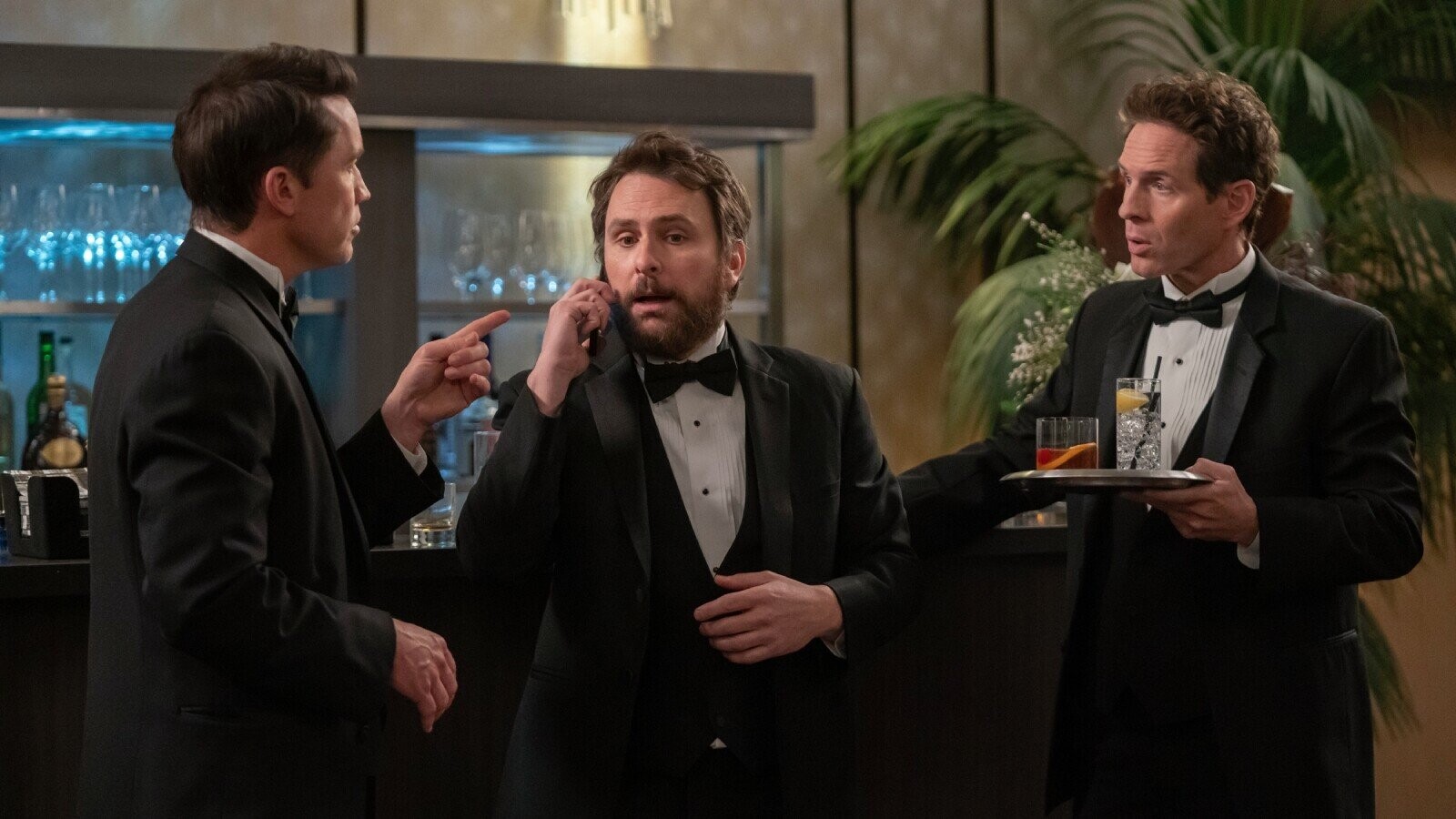
Rather than quietly reflecting on Frank’s role in their lives, Mac, Charlie and Dennis attend an upscale gathering filled with wealthy Philadelphians. Their goal is to find a replacement investor and revive what they describe as the original vision for Paddy’s Pub.
Charlie insists Paddy’s was always meant to be a global brand. Mac supplies the elevator pitch: It will be the Starbucks of dive bars. Dennis adds the comforting promise of a friendly neighborhood watering hole delivered to everyone.
That language sounds almost professional until one remembers the product being offered. Paddy’s is not friendly. It barely qualifies as neighborly. Customers are frequently ignored, mocked, manipulated or drafted into a scheme they did not know existed. The owners spend more time arguing beside the bar than serving anyone across it.
The proposed chain would therefore reproduce Paddy’s greatest weaknessits managementat industrial scale.
Why “Starbucks for Dive Bars” Is Such a Perfectly Bad Idea
The Gang Confuses Familiarity With a Brand
Successful chains give customers a predictable experience. A traveler can enter a familiar coffee shop in an unfamiliar city and roughly know what will be available, how it will be ordered and what the environment will feel like.
Paddy’s offers consistency too, but not the profitable kind. A customer can reliably expect the owners to be distracted, the atmosphere to be hostile and the business to close without warning because someone has decided to hunt treasure, solve a conspiracy or become famous before dinner.
A recognizable sign is not enough to create a brand. A scalable company needs standards, training, quality control, financial discipline and an operating system that another location can reproduce. Paddy’s cannot consistently operate one Paddy’s.
Opening 500 more would not fix the original bar. It would simply provide 500 additional buildings in which Mac and Dennis could argue about who is in charge.
There Is No Clear Customer
A serious business plan defines its target market. The Gang’s target market appears to be “every person, everywhere, all the time.” That explains the proposed locations in airports, malls, schools, churches and drive-thru lanes.
Those settings serve radically different groups with different expectations, regulations and reasons for being there. Airport customers value speed and convenience. Neighborhood-bar customers may value atmosphere and familiarity. Mall visitors want accessibility. Schools and churches are not waiting for an aggressively managed dive-bar franchise to solve an unmet consumer need.
The Gang treats market research as an insult. Instead of finding people who want the product, they assume everyone secretly wants Paddy’s and simply has not been informed loudly enough.
The Drive-Thru Concept Raises More Questions Than It Answers
A drive-thru Paddy’s is the kind of idea that sounds efficient for approximately one second. Then nearly every word in the phrase becomes a legal, operational or public-safety question.
What exactly is being sold? How would age verification work? What would responsible service look like? Who carries the insurance? How does the business prevent an already chaotic customer interaction from becoming a moving chaotic customer interaction?
None of those concerns enters the pitch. The Gang has discovered the entrepreneur’s shortcut: If you never calculate the risks, the spreadsheet remains wonderfully positive.
A Real Investor Would Escape Before the Second Slide
Actual investors generally examine the management team, market, operating model, financial records and proposed use of funding. A company seeking franchise-style expansion would also need standardized procedures, legal disclosures, contracts, training materials and credible estimates of what a new location costs and earns.
The Paddy’s presentation offers none of that. There is no evidence of steady revenue, loyal customers, protected intellectual property, reliable accounting or competent leadership. There is not even evidence that the current location can remain open without Frank repeatedly injecting money into it.
The pitch rests on three unsupported assumptions:
- People everywhere want a standardized dive-bar experience.
- The Paddy’s name has positive value outside the Gang’s imagination.
- Mac, Charlie and Dennis are capable of supervising expansion.
The third assumption may be the funniest. Charlie struggles with basic written communication. Mac turns routine decisions into identity crises and demonstrations of authority. Dennis believes charisma can replace accounting, market data and human decency. Together, they are less a management team than three separate warning labels sharing a blazer.
Even their comparison to Starbucks is poorly understood. Starbucks grew through carefully managed company-operated and licensed locations, supported by logistics, product standards, training and an internationally recognizable customer experience. The Gang seems to believe Starbucks succeeded because somebody said, “Coffee, but everywhere,” and wealthy strangers immediately started writing checks.
The Scheme Reveals What Frank Really Does for the Gang
Frank is often treated as the most unrestrained member of the group. He funds outrageous plans, embraces filth, encourages conflict and can turn a minor inconvenience into a criminal-adjacent carnival before lunch.
Yet “Frank Is in a Coma” reminds viewers that he also functions as the Gang’s financial shock absorber. Paddy’s survives not because it is healthy, but because Frank can keep paying for the consequences of everyone else’s decisions.
When Frank appears unavailable, the men immediately seek new capital. They do not reduce spending, examine the books or improve the bar. They search for another wealthy person who can be persuaded to finance the dream.
That is an important distinction. The Gang does not really want an investor. An investor asks questions and expects results. They want another Frank: someone with money, flexible judgment and no immediate desire to inspect a balance sheet.
Their search eventually produces a profoundly unreliable prospect, and the grand expansion collapses. When they return to Frank, he dismisses the worldwide Paddy’s concept as a terrible idea. Coming from Frank Reynolds, that judgment should carry the emotional force of a building inspector whispering, “I have never seen walls do that.”
The Joke Connects Season 17 to the Very Beginning
The franchise plan also reaches back to the earliest version of It’s Always Sunny in Philadelphia. In the pilot, “The Gang Gets Racist,” Paddy’s unexpectedly attracts a large gay clientele. Mac resists the successful change partly because he remembers the bar as a place the men opened to improve their social and romantic prospects.
That early episode established a pattern the series has repeated ever since. The Gang occasionally stumbles into a potentially profitable idea, but personal insecurity destroys it. They would rather control a failing business than adapt to a successful one that does not flatter them.
Later episodes have shown Paddy’s becoming an underage hangout, being considered for a corporate purchase, receiving a promotional billboard and earning a reputation as one of Philadelphia’s worst bars. The owners repeatedly attempt advertising, rebranding, merchandising and special events. A useful idea usually appears somewhere in the chaos, only to be smothered by vanity, jealousy or an argument about who deserves credit.
The Season 17 revelation makes those failures even funnier. Mac, Charlie and Dennis were apparently not conducting isolated experiments. In their revised personal history, every disastrous promotion was part of a journey toward worldwide domination.
Why Paddy’s Pub Still Works as a Television Setting
As a real bar, Paddy’s would be a crisis. As a sitcom location, it is nearly perfect.
The room is plain enough to support almost any story. It can become a campaign office, courtroom, performance venue, business headquarters, quarantine zone or laboratory for Frank’s latest theory. The physical space remains familiar while the Gang’s interpretation of it changes every week.
Paddy’s also traps the characters together. They can dream about becoming celebrities, entrepreneurs, political leaders or cultural icons, but they eventually return to the same dim room and the same damaged relationships. The bar is both their castle and their cage.
That contradiction helps explain the show’s unusual longevity. The Gang wants endless growth without personal growth. Technology, politics, language and popular culture change around them, but they continue filtering every trend through greed and wounded pride. A global Paddy’s franchise therefore feels like a natural ambition. It promises expansion without requiring any of them to become better.
Real-World Experiences That Feel Suspiciously Like a Paddy’s Meeting
Anyone who has participated in a chaotic group project, startup meeting or family business may recognize the uncomfortable truth beneath the comedy. Bad organizations do not always lack ideas. Frequently, they suffer from too many ideas and no reliable method for evaluating them.
A Paddy’s-style meeting usually begins with a slogan. Someone announces that the company will become “the Uber of landscaping,” “the Netflix of sandwiches” or “the Starbucks of dive bars.” The comparison creates a burst of excitement because it makes a complicated business sound complete. Unfortunately, attaching one famous company to an unrelated noun is not a strategy. It is business-themed refrigerator poetry.
The next symptom is immediate expansion. Before proving that one location works, the group starts discussing 50 locations, an app, international licensing and branded merchandise. Basic questions are treated as pessimism. How much will it cost? Who is the customer? Who performs the daily work? What happens when something goes wrong? Those questions are postponed until after the imaginary grand opening.
Then personalities replace responsibilities. One person appoints himself the visionary. Another becomes “head of operations” despite never having operated anything. A third volunteers to handle marketing because he has an active social-media account. Nobody wants bookkeeping, compliance, staffing or inventorythe unglamorous work that determines whether a business opens again tomorrow.
The Gang repeatedly makes this mistake. Dennis wants the prestige of leadership. Mac wants the authority attached to leadership. Charlie wants to contribute ideas without translating them into conventional language. They enjoy titles because titles provide the emotional reward of success before any successful work has occurred.
Healthy teams slow this process down. They test a small version of the idea, assign clear roles and decide which measurable result would indicate progress. They separate brainstorming from approval. Most importantly, they allow someone to say, “This does not make sense,” without declaring that person an enemy of innovation.
A real-world version of the Paddy’s expansion might start with something modest: improve service at the existing bar, track daily sales, create a limited menu, repair the facilities and test one recurring event. After several months of measurable improvement, the owners could assess whether the concept has repeatable value.
The Gang would consider that approach painfully boring. There would be no gala, no dramatic investor pitch and no opportunity for Dennis to stand beside an easel while speaking as if he had personally invented commerce. Yet boring systems are often what make growth possible.
Another recognizable experience is the search for a financial rescuer. Struggling teams sometimes believe the only missing ingredient is more money. New funding can help a sound operation grow, but it cannot permanently repair undefined roles, uncontrolled spending or leaders who refuse to learn.
Paddy’s does not primarily have a capital problem. It has a Gang problem. Giving the owners more money simply allows them to produce larger failures with better catering.
That may be the most useful lesson hidden inside the episode. Ambition is not evidence. Confidence is not preparation. A catchy analogy is not a market analysis. And when the least cautious person in the room calls your plan terrible, it may be time to cancel the drive-thru church location.
Conclusion: The Worst Plan Is Also the Perfect Paddy’s Plan
The original Paddy’s Pub business plan is doomed by every conventional standard. It lacks market research, financial discipline, operational controls, legal realism and trustworthy leadership. Its expansion targets range from optimistic to socially bewildering. The existing flagship location is barely a functioning business, and its owners cannot agree long enough to finish a normal conversation.
As an It’s Always Sunny in Philadelphia story, however, the plan is flawless.
It transforms the Gang’s oldest weaknesses into a grand entrepreneurial vision. Mac mistakes enthusiasm for expertise. Charlie treats an old fantasy as established corporate history. Dennis assumes wealthy people will invest because he delivers the pitch confidently. Frank remains the financial engine everyone resents until they need another check.
Paddy’s will probably never become the Starbucks of dive bars. It does not need to. After 17 seasons, one terrible location has already created more chaos than most international chains could manage.